The title ‘Bhikkhu’ is more than a religious term — it represents a way of life and a core spiritual ideal that has shaped Buddhism for over two millennia. The emergence of the monastic community (Saṃgha) wasn’t a random event; it was the fulfillment of the Buddha’s own mission.
According to the scriptures, the Buddha declared that he would not enter Nirvāṇa until a strong and complete fourfold community (cattāri parisā) had been established: Bhikkhus, Bhikkhunīs, Upāsakas, and Upāsikās. These four groups form the essential foundation that ensures the Dhamma and Vinaya are preserved, practiced, and passed down faithfully through generations.
This article offers a full look at who Bhikkhus are — beginning with their original meaning and historical roots. We’ll explore the path of ordination, the disciplinary rules that shape monastic life, and the daily practices that have sustained this tradition for thousands of years. Finally, we’ll look at the role, challenges, and adaptations of Bhikkhusin today’s complex and fast-changing world.
Join Buddha Student in exploring the spiritual depth and historical significance behind this respected title, and gain a clearer understanding of those who have dedicated their lives to the path of awakening.
Who Are Bhikkhus? Meaning & Role in Buddhism

To truly grasp the essence of monastic life, understanding the terminology is the first and most fundamental step. The term ‘Tỳ kheo’ is more than a title; it reveals the foundational principles of the renunciant path, reflecting both the way of livelihood and the ultimate spiritual purpose.
Origin & Meaning
The word ‘Bhikkhu’ comes from ancient Indian languages and carries two deeply significant layers of meaning:
Linguistic Roots: Derived from the Pāli word Bhikkhu and the Sanskrit word Bhikṣu.
Two Layers of Meaning:
- Literal meaning: “One who lives on alms” or “one who receives offerings for sustenance.”
This highlights the principle of renouncing material ownership, accumulating no possessions, and depending entirely on the support of lay followers. It establishes the foundation of the reciprocal relationship between the monastic community and society. - Spiritual meaning: “One who sees the danger in saṃsāra.”
This expresses the ultimate purpose of monastic life: not merely to live simply, but to cultivate the mind, transform the heart, and attain complete liberation from the cycle of birth and death (Nirvāṇa).
Clarifying a Common Misunderstanding
A common misconception needs to be cleared up: the Pāli term Bhikkhu is not the name of a plant or any type of vegetation.
The confusion arises from a homonym in Sanskrit. The word Bhikṣu is also used as a local name for the medicinal plant Hygrophila schulli (also known as Neermulli) in traditional Indian medical systems such as Ayurveda. However, this usage is entirely separate and unrelated to the meaning of the term in Buddhist scriptures. Distinguishing this clearly is essential to avoid misinterpreting one of Buddhism’s core concepts.
With this foundational understanding, we can move on to explore the historical context behind the formation of the very first monastic community established by the Buddha himself.
Historical Foundations & the Emergence of the Monastic Community
The establishment of the Buddha’s monastic community was a revolution in both spiritual and social thought in ancient India. He created a path open to all—regardless of caste, gender, or background—allowing anyone to pursue enlightenment. This was a direct challenge to the rigid Brahmanical structure of the time and laid the groundwork for a sustainable spiritual community.
The Formation of the Fourfold Assembly
Right after his enlightenment, the Buddha was determined to create a strong Buddhist community composed of four groups, known as the Fourfold Assembly (cattāri parisā):
- Bhikkhus: Fully ordained male monastics.
- Bhikkhunīs: Fully ordained female monastics.
- Upāsakas: Male lay followers who have taken refuge in the Triple Gem and observe the Five Precepts.
- Upāsikās: Female lay followers who have taken refuge in the Triple Gem and observe the Five Precepts.
These four groups form the social foundation of the Dhamma, ensuring that the teachings are preserved not only within the monastic order but also practiced and supported by the lay community.
The Emergence of the Bhikkhunī Saṃgha
The establishment of the Bhikkhunī Order is one of the most significant milestones in Buddhist history, reflecting the Buddha’s inclusive and egalitarian vision. The story begins with Mahāpajāpatī Gotamī—the Buddha’s aunt and foster mother. After the passing of King Suddhodana, she led a group of 500 Sakyan women on a long journey to request permission for women to enter monastic life.
Initially, the Buddha refused. However, after Venerable Ānanda’s heartfelt intercession, the Buddha consented on the condition that female monastics observe the Eight Garudhammas (Eight Respect Rules). Mahāpajāpatī accepted them without hesitation and became the first Bhikkhunī in history.
Her role, along with that of subsequent Bhikkhunīs, was formally honored by the Buddha himself. When Mahāpajāpatī passed into final Nirvāṇa, the Buddha walked behind her funeral bier—a gesture of profound respect that he had not shown for anyone else, not even his father or his senior disciples—affirming the importance of the Bhikkhunī Order.
The founding of both the Bhikkhu and Bhikkhunī Saṃghas laid the groundwork for a structured monastic life, maintained and transmitted over millennia, forming the framework for the path of practice and liberation.
The Path of Ordination
Becoming a Bhikkhu is not an impulsive decision but a deeply committed process formalized through ordination rituals and adherence to a disciplined way of life. This process ensures that a monastic is mentally and practically prepared to enter the life of purity.
The Ordination Process
The path to becoming a Bhikkhu typically involves two main stages:
- Pravrajyā (Novice Ordination):
This is the ritual of “going forth” from the household life into homelessness, marking the transition into a novice monk, known as a Śrāmaṇera. Although traditionally performed for young candidates (as early as age 8), it is also applicable to adults entering monastic life. - Upasaṃpadā (Higher Ordination):
This is the formal ceremony through which one becomes a fully ordained Bhikkhu. To qualify, a candidate must be at least 20 years old, free from contagious diseases, unburdened by serious criminal offenses, and must have permission from their parents. The ceremony must be conducted and confirmed by a quorum of at least ten qualified Bhikkhus.
The Foundation of Monastic Life (The Four Requisites)
A Bhikkhu’s life is grounded in the principle of few wants and contentment and relies on the four essential requisites, known as Cattāro Nissayā. These items form the basis of the reciprocal relationship between the monastic community and lay supporters, who cultivate merit through their offerings.
- Robes (Cīvara):
Clothing used for covering and protecting the body. In early Buddhism, robes were made from discarded cloth—“rags from rubbish heaps”—and dyed with natural materials such as tree roots or bark to create the characteristic earthy brown tone, symbolizing renunciation. - Food (Āhāra):
Daily sustenance required to maintain life. Traditionally, Bhikkhus receive food through the morning alms-round (piṇḍapāta). - Lodging (Senāsana):
Places for rest and meditation. These originally included the base of a tree or caves and later evolved into monasteries (vihāras) donated by lay followers. - Medicine (Gilānapaccayabhesajja):
Necessary remedies for treating illness and maintaining health.
This simple monastic lifestyle—supported by the four requisites—is guided by daily practices and a strict disciplinary code designed to purify body and mind.
The Daily Life of a Bhikkhu
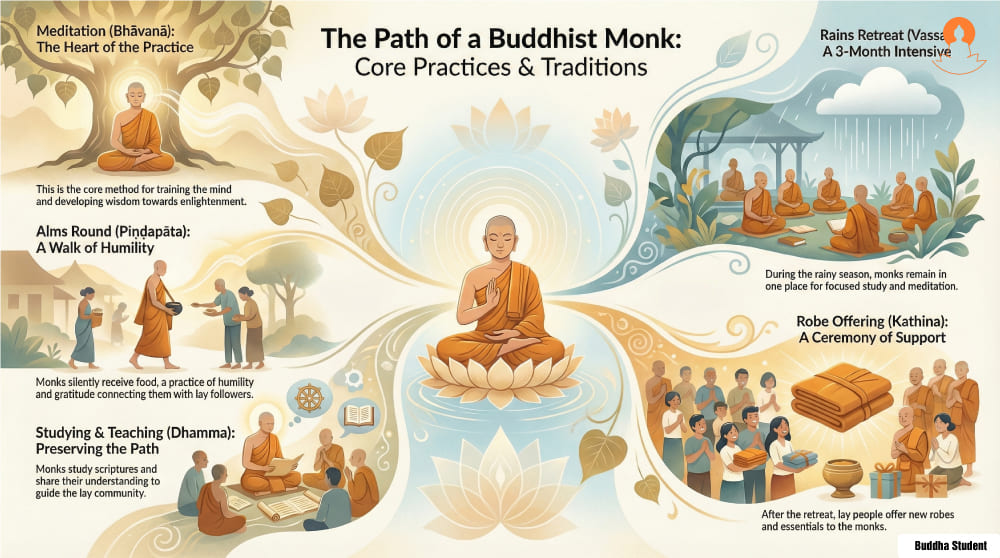
The daily life of a Bhikkhu is a continuous practice of mindfulness, structured around core activities that cultivate personal spiritual development and serve others through the transmission of the Buddha’s teachings.
Alms-Round (Piṇḍapāta):
This is far more than the act of receiving food. The alms-round is a profound practice of humility, gratitude, and an opportunity for lay devotees to cultivate merit. During the alms-round, a Bhikkhu walks silently, with eyes lowered, maintaining a calm and mindful presence. This practice is part of the Sekhiya training rules within the Vinaya, designed to cultivate proper conduct and mindfulness. The image of devotees removing their shoes, waiting respectfully with offerings placed on a small table before placing them into a monk’s bowl, beautifully illustrates this reciprocal relationship.
Meditation (Bhāvanā):
Meditation is the central activity and occupies much of a monk’s day. The Buddha himself set the example with a daily schedule devoted largely to meditation. This is the primary method for training the mind, developing wisdom, and moving toward liberation.
Studying and Teaching the Dhamma:
Bhikkhus are the guardians and transmitters of the Buddha’s teachings. They spend time studying the scriptures and sharing their understanding with the lay community, helping them apply the Dhamma in daily life.
Rains Retreat (Vassa):
Vassa is a three-month intensive retreat observed annually during the rainy season. During this period, Bhikkhus remain in one location to focus on study, meditation, and spiritual discipline. This tradition originated from the intention to avoid harming young plants and insects that flourish during the rainy months.
The Kathina Robe Offering Ceremony:
At the end of the three-month retreat, the traditional Kathina ceremony is held. Lay devotees offer new robes and other necessary requisites to the Sangha. Traditionally, the Kathina robe is sewn overnight by the lay community and offered the next day, symbolizing deep devotion and collective effort.
All of these activities are shaped and guided by the comprehensive ethical and disciplinary framework known as the Vinaya.
Vinaya: The Ethical Framework of the Monastic Life
The Vinaya is not a set of punitive restrictions but a carefully designed ethical framework created by the Buddha to safeguard monastic life. It establishes a supportive environment for cultivation, prevents unwholesome actions, preserves harmony within the Sangha, and builds trust with the lay community.
The Pāṭimokkha
The core disciplinary code of the Vinaya is known as the Pāṭimokkha. This collection of rules is recited twice a month—on the full moon and new moon days—during the Uposatha ceremony. It is an opportunity for Bhikkhus to reflect on their observance of the precepts and confess any violations, thereby maintaining purity both individually and collectively.
The Most Serious Offenses
Among all monastic rules, four are considered the most severe. A Bhikkhu who commits any of these offenses is permanently expelled from the Sangha. These are known as the Pārājika offenses, meaning “defeat” or “overturning.”
- Sexual intercourse: Engaging in sexual activity.
- Stealing: Taking property of significant value, equivalent to grand larceny under ancient legal standards.
- Killing: Intentionally killing a human being or encouraging someone to take their own life.
- False claims of spiritual attainment: Falsely declaring attainment of superior states (such as jhānas or noble attainments).
In addition to these, there are many other important rules: abstaining from handling money, maintaining complete celibacy, and refraining from eating after noon (from midday until dawn).
Differences Across Traditions
The number of rules in the Pāṭimokkha varies slightly among the major Vinaya traditions that have survived to the present day, reflecting developments within early Buddhist schools.
| Tradition | Geographic Region | Bhikkhu Rules (approx.) | Bhikkhunī Rules (approx.) | Status of Bhikkhunī Lineage |
|---|---|---|---|---|
| Theravāda (Pāli) | Sri Lanka, Southeast Asia | 227 | 311 | Extinct (revival efforts ongoing) |
| Dharmaguptaka | East Asia, Vietnam | 250 | 348 | Surviving |
| Mūlasarvāstivāda | Tibet, Himalayan regions | 253 | 364 | Extinct (recent revival initiatives) |
Despite these numerical differences, all Vinaya traditions share a common ethical foundation and aim toward the same ultimate goal: liberation. These disciplinary codes apply equally to the Bhikkhunī Saṃgha, forming a parallel and complementary monastic path.
The Bhikkhunī Saṃgha: A Parallel Path
In the early Buddhist teachings, the Buddha affirmed that women possess the same potential for enlightenment as men. The establishment of the Bhikkhunī Saṃgha not only opened a path of liberation for women but also completed the Fourfold Assembly, creating a vital complementary role in the propagation of the Dhamma—especially in guiding and supporting female lay practitioners.
History, Decline, and Revival
After its establishment in India, the Bhikkhunī lineage spread vigorously to Sri Lanka through Princess Saṅghamittā, daughter of King Aśoka. From Sri Lanka, it later expanded to China, giving rise to generations of highly learned and accomplished nuns.
However, due to historical upheavals such as wars and invasions—most notably the Chola invasion of Sri Lanka in the 11th century—the Theravāda Bhikkhunī lineage was disrupted and eventually disappeared.
In contrast, the Bhikkhunī ordination lineages within Mahāyāna Buddhism continued uninterrupted and have flourished to the present day in countries such as China, Vietnam, and Korea.
The Debate on Restoration
In recent decades, a strong movement has emerged advocating for the revival of the Bhikkhunī lineage within the Theravāda tradition. Debates regarding its legitimacy often center on how the Vinaya rules should be interpreted.
At the heart of the issue is the rule of dual ordination, which requires the participation of both the Bhikkhu Saṃgha and the Bhikkhunī Saṃgha to ordain a new Bhikkhunī. Since the Theravāda Bhikkhunī lineage has vanished, some argue that restoration is impossible.
However, deeper scholarly analyses of the Vinaya—such as the work of Bhikkhu Anālayo—highlight a crucial point that is frequently overlooked: the two rules governing Bhikkhunī ordination were introduced for two entirely different contexts.
- Ordination by the Bhikkhu Saṃgha alone: This rule was instituted in the initial phase, when the Bhikkhunī Saṃgha did not yet exist and needed to be established for the first time.
- Dual ordination: This rule was introduced later, once the Bhikkhunī Saṃgha was already present and sufficiently developed to participate in the ordination process.
Thus, the two rules are not contradictory nor mutually exclusive; they apply to distinct historical circumstances. This reasoning supports the view that ordination conducted solely by the Bhikkhu Saṃgha is fully valid—and consistent with the spirit of the Vinaya—when reviving the Bhikkhunī lineage in places where it has lapsed.
Just like the Bhikkhunī Saṃgha, the role of Bhikkhus in general is also facing challenges and transformations in an ever-changing world.
Monks in the Modern World
While the core principles of monastic discipline and practice remain unchanged, the roles and methods of Buddhist monks today are continually adapting to the complex challenges and opportunities of the contemporary world. Modern monastics are no longer solely secluded meditators; they have also become educators, social activists, and spiritual guides within an increasingly globalized society.
Engaged Buddhism:
This is a movement in which monastics actively participate in social issues, grounded in the Buddhist ideals of compassion and wisdom. Instead of focusing solely on personal liberation, monks devote themselves to causes such as poverty alleviation, environmental protection, and human rights advocacy.
Venerable Thich Nhat Hanh is a prominent example—he opposed the Vietnam War and led the Buddhist delegation at the Paris Peace Talks in 1969. Another figure is Bhikkhu Bodhi, founder of Buddhist Global Relief, a nonprofit dedicated to combating hunger and malnutrition worldwide.
Political Involvement:
This remains a highly debated topic. The Vinaya generally discourages monastics from engaging in partisan politics, as it may lead to conflict and compromise the purity of the monastic life. However, in some countries such as Myanmar, monks—due to their significant moral authority—sometimes use their influence to speak out on social ethics or defend the rights of citizens facing injustice. Such involvement walks a fine line between social responsibility and the preservation of monastic integrity.
Monastics in the Digital Age:
Modern technology—especially smartphones and social media—introduces unprecedented challenges to the Vinaya. Rules regarding entertainment, communication, and possession are no longer straightforward to apply. The deciding factor is intention.
Using technology to teach the Dhamma, connect with lay followers, or support study is seen as wholesome.
Using it for personal entertainment, self-promotion, or distractions is considered unwholesome and contrary to the spirit of the monastic code.
These forms of adaptation reveal the resilience and vitality of the monastic community as it continues to meet the spiritual needs of our time while preserving its essential values.
Final Thought
Through the lens of history and the Buddha’s teachings, the image of a bhikkhu emerges not merely as a robe-clad ascetic but as a living symbol of renunciation and spiritual dedication. Carrying the dual meaning of “one who lives by alms” and “one who sees the danger in the cycle of rebirth,” a bhikkhu embodies the very path the Buddha laid down—a path of liberation from suffering for all beings.
Although the outer forms and methods may evolve across different eras—from walking barefoot on alms rounds in ancient villages to using digital technology to share the Dhamma in the 21st century—the essence of the monastic role remains unchanged. Monks continue to be guardians and transmitters of the teachings, moral exemplars for the community, and spiritual guides who help others find inner peace.
In a world constantly shifting, filled with anxiety and uncertainty, the life of a true bhikkhu remains a spiritual lighthouse, illuminating the way of mindfulness, compassion, and wisdom. The endurance of the monastic order for more than 2,500 years stands as powerful testimony to the timeless value and enduring necessity of the path they have chosen.