
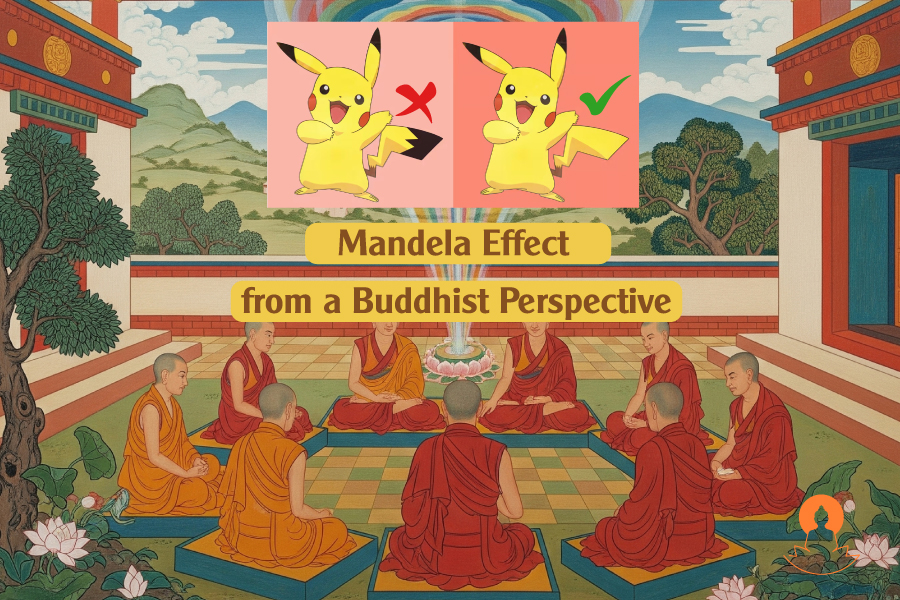
In today’s modern world, where collective memory is easily swayed by media, social networks, and cognitive distortions, the Mandela Effect has emerged as a phenomenon worth pondering: Why do so many people vividly remember events or details that never actually happened?
When viewed through the lens of Buddhist philosophy—particularly the doctrines of dependent origination (pratītyasamutpāda), non-self (anattā), and ignorance (avidyā)—memory is no longer just a “distorted fragment.” It becomes a mental illusion, arising and fading like a wave in the ever-changing ocean of consciousness.
In this article, Buddha Student will guide you through three key parts:
- What is the Mandela Effect?
- The psychological perspective
- And finally, the Buddhist understanding of this curious phenomenon.
What Is the Mandela Effect?
The Mandela Effect refers to a phenomenon in which a large number of people share the same false memory of a past event or detail—often with unwavering confidence, even when the facts say otherwise.
The term “Mandela Effect” was first coined in 2009 by Fiona Broome, after she created a website to document strange memories she—and many others—seemed to share. During a conference, Broome was shocked to discover that many people, like herself, “clearly remembered” Nelson Mandela dying in prison during the 1980s. In reality, Mandela passed away in 2013, years after serving as President of South Africa.
Since then, the Mandela Effect has become a symbol of collective false memory, raising profound questions:
Can we truly trust our memories? Or is the mind quietly reshaping reality into what it wants to believe is true?
Here are some of the most well-known examples of the Mandela Effect:

Do You Remember Pikachu’s Tail Having a Black Tip?
- Many people confidently recall that Pikachu’s tail had a black tip.
- But in reality, Pikachu’s tail has always been completely yellow—from base to tip—with no black markingswhatsoever.

Do You Think the Old Man from Monopoly Wears Glasses?
- Many people firmly believe that the Monopoly Man wears a monocle—that single eyeglass often associated with wealth and sophistication.
- But here’s the surprising truth: He never wore one. Not a monocle. Not even regular glasses.

Do You Remember Mickey Mouse Wearing Suspenders?
Even the world’s most iconic cartoon character isn’t immune to the Mandela Effect.
Many people clearly remember Mickey wearing red shorts with suspenders.
But the truth is: Mickey Mouse has never worn suspenders. He simply wears plain red shorts with two yellow buttons—and that’s it. His upper body? Completely bare.
A surprisingly bold fashion choice for one of the most beloved children’s characters on the planet!

How Do You Remember the Smile of the Mona Lisa?
Many people believe that the Mona Lisa once wore a clearer smile—gentle, warm, even radiant.
But in truth, her smile has always been elusive—a faint, fleeting expression, as if it were just passing through.
It was never fully there.
And perhaps, that very ambiguity is what gives the painting its timeless mystery.
So why do so many “remember” a brighter smile?
Did another version once exist?
Or has the mind painted the smile it wished to see?
Countless theories have been offered—ranging from visual illusions and lighting effects to the idea of parallel realities.
But maybe, just maybe, as Leonardo da Vinci himself may have hinted:
Her smile doesn’t live in the painting—it lives in the eyes of those who behold her.
“We like to believe we understand our own minds—that memory is something we can trust. But the Mandela Effect is one of those rare moments when memory betrays us, leaving behind a chilling, unexplainable sensation.”
These are the words of Dr. Wilma Bainbridge, psychology professor at the University of Chicago and one of the world’s leading experts on the Mandela Effect.
The Mandela Effect strikes at the heart of a fundamental belief: that memory equals truth.
When we discover that something we clearly remember—never actually happened. it’s not just surprising. It’s a shock to our very sense of self.
That eerie feeling of being misled by your own brain is what makes this phenomenon so hauntingly fascinating.
It’s not just a memory puzzle.
It’s a gateway into deeper questions about reality, memory, and human perception.
In the digital age, the internet doesn’t just store information—it shapes our collective memory.
This is especially true in the Mandela Effect, where large groups of people misremember the same event that never took place.
Here’s how it happens:
Someone shares a memory online—even if it’s false.
Others read it, and it resonates with something faint in their own memory.
If there’s even a small overlap, the brain tends to “link” with that version of the story.
Have you ever thought: “Wait… I remember it exactly like that!”
And just like that, a false memory spreads, is repeated, and gradually becomes collective belief.
A large-scale study analyzing over 100,000 viral stories on Twitter over a decade revealed:
False news and rumors spread up to 70% faster than the truth.
And here’s the twist:
It wasn’t bots.
It wasn’t AI.
It was real people—sharing with genuine belief.
The Mandela Effect from a Psychological Perspective
Some of the Most Widely Accepted Psychological Explanations
False Memories
One of the most logical and scientifically supported explanations for the Mandela Effect is the phenomenon of false memories.
A false memory occurs when a person vividly remembers an event or detail that, in reality, never happened. What makes it striking is that the person is completely unaware of the inaccuracy—they wholeheartedly believe the memory is true.
False memories are not lies. They are natural errors in the brain’s process of encoding, storing, and retrieving information. And this forms one of the most solid psychological foundations for understanding the Mandela Effect.
Memory Is Not a Recording Device
Memory is not a recording — it’s a reconstructive process.
Many people believe that memory works like a camera: recording the past accurately and playing it back when needed. But in reality, memory is a reconstruction process — flexible, easily distorted, and prone to error.
Neuroscience has shown that:
- The process of storing memory traces is called engram — a network of neural connections formed after an experience.
- The system that organizes and links related memories is called a schema — a network of cognitive frameworks that help us categorize and interpret information.
The Fragmented Nature of Memory
When a memory is “recalled,” it is not intact — it is reconstructed based on the present context.
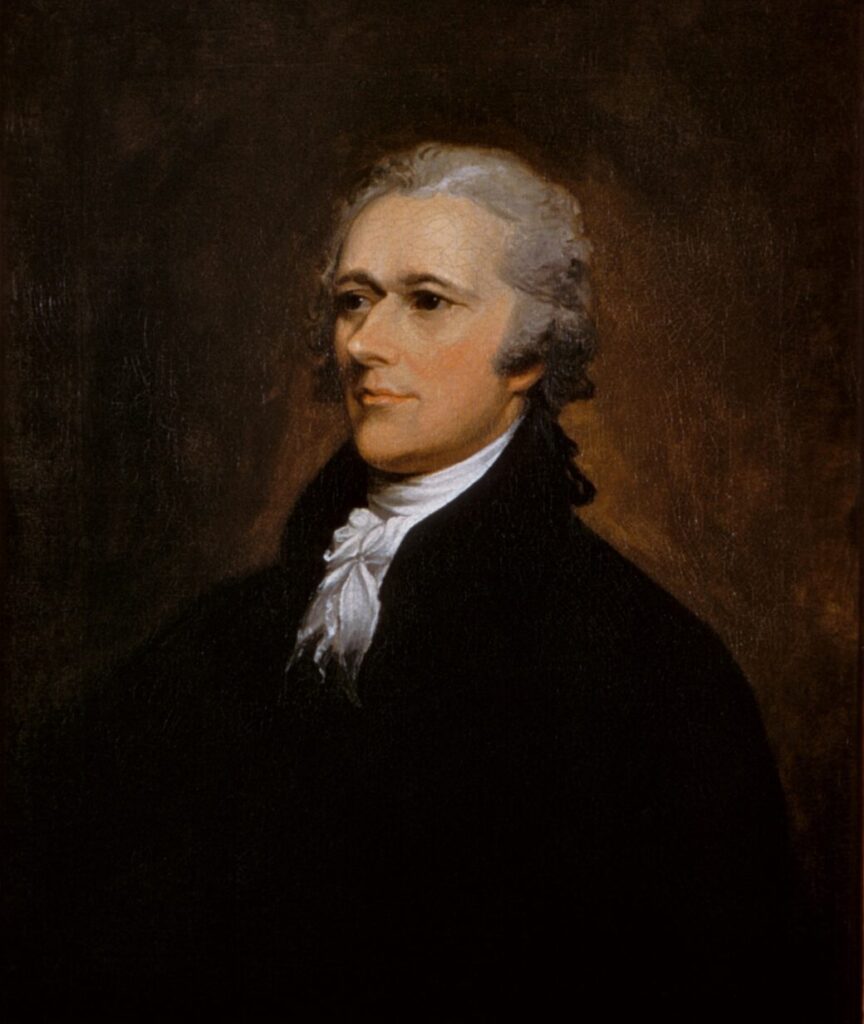
Besides the earlier examples, one notable case is Alexander Hamilton:
Most Americans learn that Alexander Hamilton was one of the Founding Fathers, but he was never a U.S. President.
Still, when asked to name former presidents, many people mistakenly include Hamilton on the list.
Why Do We Misremember?
When you try to recall Hamilton, your brain activates neurons associated with related information.
If your memories of U.S. presidents and Hamilton are stored within overlapping schema networks, they may interferewith one another.
Your brain may unconsciously “pull” related memories about presidents and associate them with Hamilton—leading you to believe something that was never true.
The Mind Doesn’t Reproduce Reality
The mind doesn’t reproduce the truth — it reconstructs a story that makes sense.
Memory is not replayed like a video clip.
It’s reassembled from scattered fragments, blending:
- Personal beliefs
- Social experiences
- After-the-fact information
- Pre-existing mental frameworks (schemas)
As a result, a memory may feel coherent and logical—yet in essence, it could be entirely inaccurate.
How False Memories Are Formed
This is how false memories take shape in the mind:
- Initial encoding of the experience or event.
- Missing details or gaps in memory.
- Gaps are filled in with assumptions or imagination (confabulation).
- External influences such as suggestion from others or media (suggestibility).
- Repetition of the false memory over time strengthens confidence in it (repetition bias).
- Eventually, the memory feels vivid and real, and is treated as fact.
The result? A memory that is completely false, yet believed to be true and when many people share the same memory, that is the Mandela Effect.
The Root of the Mandela Effect
The Mandela Effect is not just a strange curiosity. It is a direct result of how the human brain organizes and reconstructs memory.
When we realize that something we were absolutely certain we saw never actually happened, it’s more than just surprising—
it’s a shock to our very sense of self.
And this is the deeper insight the Mandela Effect reveals:
We are not merely remembering the past.
We are reconstructing it—through the lens of the present, our beliefs, and the unconscious mind.
The Fringe Theories Beyond Mainstream Science
Although mainstream psychology largely attributes the Mandela Effect to false memories, some believe it stems from deeper distortions in the nature of reality itself.
Here are five of the most well-known fringe theories beyond mainstream science:
1. Alternative Realities
This theory suggests that there are multiple parallel realities, each with its own timeline.
People who remember events “incorrectly” may have actually experienced them in a different timeline, where those events truly occurred — before somehow shifting into another reality, where things are different.
2. Parallel Universes / Multiverse Theory
Based on quantum mechanics and string theory, this hypothesis argues that the universe is not singular, but instead part of a multiverse — a set of parallel universes where versions of reality coexist simultaneously.
From this view, the Mandela Effect may be residual memory left behind when multiple universes intersect or when one “jumps” into another version of reality that quantum science still struggles to explain.
3. Glitch in the Matrix
Inspired by the film The Matrix, this theory proposes that we are living in a simulated reality — a kind of computer program.
When the “system” updates or changes something in the simulation, minor details may shift, but some individuals retain memories of the “pre-update” version, causing the Mandela Effect.
4. Time Manipulation
This theory suggests that certain events (possibly through time travel or advanced technology) have altered the past, and the Mandela Effect is the unintended side effect of those changes.
While there is no concrete evidence, this theory often draws interest from those who believe in secret experiments or government manipulation of time.
5. Mass Data Manipulation and Information Control
Another theory speculates that global powers may be manipulating or controlling information as part of psychological experiments on mass memory.
Small details (like logos, quotes, or timelines) may have been deliberately altered, and the Mandela Effect is simply a reaction to these strategic disruptions, testing the limits of public perception and resistance to misinformation.
The Mandela Effect from a Buddhist Perspective

According to the Dhammapada, the Buddha taught:
“The mind is the forerunner of all things. The mind creates, the mind leads all states.”
This means that all perceptions, experiences, and even the world we live in are products of the mind. The mind doesn’t merely record reality — it “paints” the world we perceive, through a process of cognition, imagination, and mental construction.
From the lens of psychology, the Mandela Effect is a striking example of this truth:
People believe in memories of events that never actually happened — not because they were deceived from the outside,
but because the mind itself filled in the gaps, constructed patterns, and reassembled fragmented information —
creating a “false” reality that feels just as real and convincing as the truth.
In Buddhist philosophy, reality is not fixed or absolute. It arises through the interdependent conditions (pratītyasamutpāda) of all things. What we call “reality” only exists through the interaction between mind and the object it perceives.
When the mind changes, so does the world it perceives. When many people share the same mental impression (even if false),
a kind of “collective reality” can be formed—not in physics, but in perception. Therefore, the Mandela Effect is not a supernatural event, but rather a direct result of deluded conceptual thinking—a process Buddhism describes as the deluded mind giving rise to mental constructs, then clinging to them as if they were real.
In the Five Aggregates (Skandhas), the mental formation aggregate (saṅkhāra) includes processes such as thought, memory, and reaction—all of which are impermanent (anicca).
Memory is not exempt from this truth. It changes over time. It is shaped by emotion, context, and influence from others. And most importantly: it is not controlled by a permanent, independent self.
Understanding this, we will no longer cling to our memories as absolute truth. Instead, we open ourselves to the possibility of misperception—without falling into confusion or fear.
The Mandela Effect Through the Lens of Non-Self
Non-self (Anattā) is the truth that:
“Bhikkhus, form is not self. If form were self, form would not lead to affliction. But because form is not self, it changes and leads to affliction.”
(Saṁyutta Nikāya, Book V – Anattā-lakkhaṇa Sutta)
Memory is a mental activity belonging to feeling – perception – formation – consciousness, which are the four aggregates apart from form in the Five Aggregates. All of these aggregates are impermanent, conditioned, without unchanging substance, and not “me” or “mine.”
Therefore, when a person says, “I clearly remember that,” Buddhism reminds us:
Who is the one remembering?
And does that memory exist independently, unchanging?
The answer is that there is no true “self” behind memory.
There is only a stream of consciousness operating based on a combination of many conditions — and since those conditions are always changing, memory also changes accordingly.
According to the Buddha’s teaching, the mind is a conditioned phenomenon:
“Bhikkhus, this mind is always changing, hard to grasp, hard to control.”
(Aṅguttara Nikāya – AN 1.6)
In the phenomenon of the Mandela Effect, the statement “I remember it very clearly” is a clear manifestation of ignorance and attachment to self.
When the perception aggregate is influenced by habit, media, and social suggestions, distorted cognition is only natural.
If a practitioner does not see this clearly, they will easily become attached to mistaken perceptions, even becoming angry or confused when reality does not match their memory.
By practicing observation of mental activities — including memory — the practitioner will clearly see:
- There is no one who is remembering.
- There is only mind and phenomena operating according to conditions.
- And when memory is no longer seen as “I,” one is no longer distressed or confused when memory fails. One can observe the mind itself changing, with calmness and mindfulness.
Therefore, the Mandela Effect becomes a lesson in the practice:
Let go of rigid perception → realize non-self → come into contact with truth beyond personal imagination.
The Mandela Effect Through the Lens of the Five Aggregates (Pañcakkhandha)
The Five Aggregates (pañcakkhandha) are the five groups of elements that make up what we call the “self,” including:
- Form (rūpa) – the body, physical matter.
- Feeling (vedanā) – sensations, feelings (pleasant, unpleasant, neutral).
- Perception (saññā) – recognition, memory, identification.
- Mental formations (saṅkhāra) – volition, mental activities, reactions, memories.
- Consciousness (viññāṇa) – awareness, discernment.
Everything we say like “I remember,” “I saw,” “I’m sure” is not an unchanging entity, but a temporary and impermanent combination of the five aggregates functioning in the present moment.
Let’s analyze a false memory through each aggregate:
| Aggregate | Role in the False Memory |
|---|---|
| Form | The brain and sense organs receive the image (e.g., a logo, a cartoon character). |
| Feeling | A feeling of familiarity, comfort, or recall when first seeing the image. |
| Perception | Misidentification – e.g., seeing the Monopoly Man and imagining he wears a monocle. |
| Mental Formations | The memory is stored, reconstructed, and pieced together based on habit, belief, and social influence. |
| Consciousness | The awareness of “I remember it this way” – but it is merely a recognition based on distorted data. |
Thus, what we call “I remember” is actually a complex interaction between the five aggregates, not a fixed “self” that is remembering some objective truth.
By understanding the Five Aggregates, we realize:
- There is no true “self” who is remembering.
- No memory is absolute.
- No “truth” exists apart from the conditioned process of mind and object.
The Mandela Effect is no longer a strange flaw of memory,
but a perfect illustration of the Buddha’s teaching on the impermanence and non-self nature of all phenomena.
Looking deeply into this phenomenon, we learn not to cling to what we think is real—
and from that, we begin to live more freely, no longer bound by the illusions created by the five aggregates.
The Mandela Effect Through the Lens of Impermanence (Anicca)
Memory does not exist as a fixed block — it is a process of reconstruction, not replay. Every time we recall something, the brain “redraws” that content, influenced by our present emotions, social environment, and new information.
The Mandela Effect — when many people misremember the same detail — is clear evidence that:
Memory is not stable, not fixed, not absolutely reliable — because it is impermanent.
We are often surprised, even confused, when we realize we remembered something incorrectly. But for a practitioner of the Buddha’s teachings, this is an opportunity for deep reflection:
“Memory is also a conditioned phenomenon, not something to be clung to.”
The Buddha did not teach us to reject memory, but to not cling to it.
The meditator, when observing every arising thought, will recognize:
Thoughts arise and cease like flowing water.
Memory is just another mental formation within that stream.
Every recollection is a moment of reassembly.
Understanding this, a practitioner is no longer disturbed by their own or others’ inaccurate memories.
Instead, they smile at the illusions of the mind — and use them as a lesson to live with greater mindfulness.
The Mandela Effect does not surprise a Buddhist.
On the contrary, it confirms the Buddha’s teaching over 2,500 years ago:
“The mind is impermanent — and all perceptions arising from it are equally unstable.”
Grasping this deeply, we learn to let go of attachment to “I saw,” “I remember,” “I’m certain” —
and instead adopt a mindful, flexible, and gentle attitude, living with a truth that is changing moment by moment.
The Mandela Effect Through the Lens of Dependent Origination (Paṭiccasamuppāda)
Dependent Origination (Paṭiccasamuppāda) is the central principle of the entire Dharma. The Buddha declared:
“Whoever sees dependent origination sees the Dharma.
Whoever sees the Dharma sees the Tathāgata.”
(Majjhima Nikāya – The Great Discourse on Origination)
Dependent origination means: all conditioned phenomena do not arise independently, but are formed by multiple interconnected causes and conditions.
No thing or event exists in isolation — all are outcomes of a complex web of causes and conditions.
According to this principle, a memory arises when all these conditions are met:
- Sense contact (seeing/hearing an event)
- Feeling (pleasant, unpleasant, neutral)
- Perception (interpretation, mental image of the event)
- Volition (intent or psychological response)
- Language, media, beliefs, social context
A memory is not an objective truth, but the result of the interaction between physical and mental factors, influenced not only by what we see, but also by what we think, imagine, or are subtly prompted to believe.
The Mandela Effect arises when a group of people misremember the same thing.
Why do so many people share the same false memory?
The Dharma answers: because shared karmic conditions have created collective false memory.
Factors such as:
- Repetitive media exposure.
- Familiar cultural patterns.
- Socially reinforced beliefs.
- Unconscious suggestions from others.
…are all conditions that produce shared false memories. When many people experience similar conditions, their resulting perception — even if incorrect — is often the same.
A Buddhist practitioner does not treat memory as the foundation of absolute truth. Instead, they see all things as a stream of causes and conditions unfolding.
Understanding this, we:
- Don’t insist: “If I remember it, it must be true.”
- Aren’t shocked when our memory — or others’ — is incorrect
- Don’t use the past as a measure of present truth
Instead, we reflect on the conditions that gave rise to memory:
when, why, by whom, and in what mental state —from there, we let go of attachment and live more mindfully with the truth of the present moment.
The Mandela Effect is a modern-day reminder that:
“What you remember isn’t always what’s true. It’s the product of dependent origination, constantly shifting according to conditions.”
Contemplating through Dependent Origination, we see:
Memory is not worth clinging to — because it is conditioned, impermanent, and without essence.
What matters is not proving who’s right,
but realizing the relativity of perception — and from there, living with more openness, compassion, and mindfulness toward ourselves and others.
Comparing the Mandela Effect: Psychology vs. Buddhism
| Aspect | Psychology | Buddhism |
|---|---|---|
| Definition of the Phenomenon | A false memory shared by many people, leading to “collective misremembering.” | A manifestation of the deluded mind — the mind fabricates distorted images and clings to them as real. |
| Primary Cause | Errors in memory processes: false memory, confabulation, suggestibility, and schema distortion. | The mind creates all phenomena — when the mind is agitated or unwholesome, perception becomes distorted. |
| Nature of Memory | Memory is a reconstructive process — imperfect and easily influenced by external factors. | Memory belongs to saṅkhāra (mental formations) — impermanent, non-self, and not to be clung to. |
| Trust in Memory | Warns that memory is not absolutely reliable. | Reminds that all perception is mentally constructed — what is seen may not be as it appears. |
| Suggested Approach | Increase awareness of cognitive bias, verify information, and reduce dependence on memory. | Contemplate the mind, release attachment to delusions, practice mindfulness to see things as they truly are. |
| View of Reality | Reality is objectively existent, but human perception of it can be flawed. | Reality is conditioned — without fixed essence, arising and ceasing based on causes and conditions. |
| Role of the Mind | The mind processes information but is prone to error. | The mind is the root of all perception and all worlds — when the mind changes, the world changes. |
| Response to Misperception | Seek to correct and distinguish right from wrong using logic and data. | Let go of attachments, do not cling to distorted impressions, abide in mindfulness and insight. |
Tạ Trung Tín (Daniel Ta) | Buddha Student


