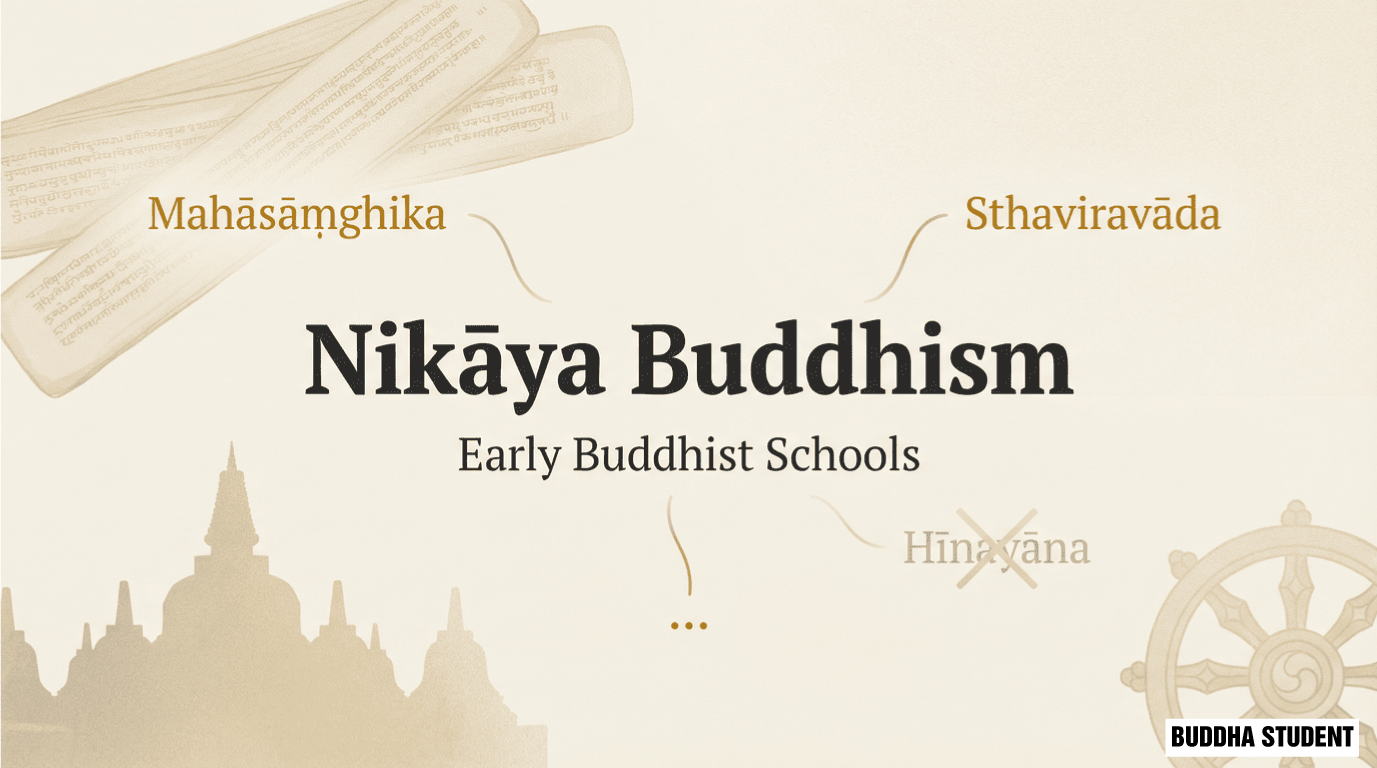
Nikāya Buddhism is a term used as a more appropriate alternative to Hīnayāna, referring to the entirety of the early Buddhist schools that emerged within the first few centuries after the passing (parinirvāṇa) of Gautama Buddha. The word “Nikāya” means “group” or “school.” It does not denote a single tradition, but rather a collection of schools that developed directly from the early monastic community, all inheriting the core teachings of the Buddha while gradually forming differences in doctrine, monastic discipline (Vinaya), and organizational structure.
In other words, Nikāya refers to these original groupings: some have continued into the present (such as Theravāda), while many others have disappeared or were absorbed into later traditions such as Mahāyāna and Vajrayāna. Nikāya Buddhism is therefore not equivalent to any single modern tradition, but is a conceptual term referring to the early monastic foundation and the initial Buddhist schools.
You may refer to the following two diagrams for easier visualization.
Gautama Buddha ~ 5th century BCE
│
└── Early Saṅgha (Pre-sectarian Buddhism)
    │
    └── Second Council (~ 4th century BCE)
        → BEGINNING OF NIKĀYA BUDDHISM (sectarian period)
        │
        ├───────────────────────────────────────────────┐
        │                                               │
        │        ←←←  NIKĀYA BUDDHISM  →→→              │
        │   (all early Buddhist schools, ~18–20 sects)  │
        │                                               │
        ├───────────────────────────────────────────────┘
        │
        ├── Mahāsāṃghika (Great Assembly)
        │     ├── (multiple sub-branches)
        │     └── (influenced later Mahāyāna thought)
        │
        └── Sthaviravāda (Elders)
              │
              ├── Sarvāstivāda
              │     ├── Vaibhāṣika
              │     └── Sautrāntika
              │
              ├── Vibhajyavāda
              │     │
              │     └── Theravāda (ONLY EXTANT NIKĀYA LINEAGE)
              │
              ├── Dharmaguptaka
              │     └── (Vinaya → East Asian Buddhism)
              │
              ├── Mūlasarvāstivāda
              │     └── (Vinaya → Tibetan Buddhism)
              │
              ├── Pudgalavāda
              │
              └── (other branches – extinct)
Historical Timeline:
5th–4th century BCE : Unified Saṅgha (NOT yet Nikāya)
4th century BCE     : Beginning of Nikāya (sectarian formation)
3rd–1st century BCE : Strong development of Nikāya (~18–20 schools)
1st century BCE →   : Mahāyāna emerges (still WITHIN Nikāya context)
1st–12th century CE : Nikāya + Mahāyāna coexist
Present             : Only Theravāda remains (Nikāya lineage)
Below are the key historical fragments as reconstructed through the perspective of Buddha Student:
A More Appropriate Term: Moving Beyond “Hīnayāna”
In contemporary Buddhist studies, the term “Nikāya Buddhism” has become the standard, neutral, and non-pejorative designation used to refer to the early Indian Buddhist schools—those traditions that developed prior to and alongside the emergence of Mahāyāna.
This terminology was proposed by Masatoshi Nagatomi (Harvard University) as a replacement for the previously widespread term “Hīnayāna.”
Establishing an objective terminological framework is not merely a linguistic concern, but a prerequisite for rigorous historical analysis. It enables scholars to examine these traditions on the basis of their own monastic (Saṅgha) heritage and distinctive doctrinal systems, rather than through a polemical lens of hierarchical opposition such as “inferior” versus “superior.”
Why Is “Hīnayāna” Inappropriate?
The term Hīnayāna is considered problematic both philologically and historically for the following reasons:
- Pejorative etymology: Literally meaning “lesser vehicle” or “inferior vehicle,” it is an exonym coined by proponents of Mahāyāna in contrast to the “Great Vehicle.”
- External imposition: No early Buddhist school ever identified itself as “Hīnayāna”; the term does not reflect the self-understanding of the traditions it labels.
- Misclassification: Technically, “Hīnayāna” refers to the paths of the Śrāvaka and the Pratyekabuddha. However, the bodhisattva ideal—central to Mahāyāna—was already present, albeit less prominent, in schools such as Sarvāstivāda and Mahāsāṃghika.
- Incompatibility with living traditions: Applying this label to contemporary traditions such as Theravāda is anachronistic and reductive, overlooking the richness of their soteriological frameworks.
Practical Significance of the Term “Nikāya Buddhism”
The adoption of the term “Nikāya Buddhism” reflects a broader shift in perspective: Nikāya refers not only to doctrinal schools but also to lineages of monastic ordination within the Saṅgha.
By identifying these groups according to their recognition of scriptural authority and their respective Vinaya traditions, scholars are better able to understand the historical development of the Saṅgha. In this way, the early schools are understood as diverse communities (nikāya), each preserving core teachings of Gautama Buddha while maintaining distinct institutional and doctrinal identities.
The Formation of Sectarian Divisions
After the parinirvāṇa (Pāli: Parinibbāna) of Gautama Buddha, the Saṅgha maintained a relative unity for approximately a century. However, as Buddhism spread across the Indian subcontinent, geographical distance and differing interpretations of monastic discipline (Vinaya) gradually led to fragmentation.
A Note on Buddhist Chronology
The chronology of early Buddhism remains highly conjectural and continues to be the subject of extensive scholarly debate. For instance, twentieth-century scholarship often dated the life of the Buddha to approximately 566–486 BCE; however, more recent studies suggest that a more plausible range may be around 484–404 BCE.
This uncertainty extends to the early Buddhist councils—assemblies convened to preserve the teachings (Dharma) and resolve disputes within the Saṅgha—whose historical details remain contested.
The First Council
Traditionally believed to have been held at Rājagaha (Skt. Rājagṛha) shortly after the Buddha’s passing, its purpose was to recite and codify his teachings and to establish the Vinaya. However, some modern scholars question whether this council occurred as a historical event in the strict sense.
The Second Council and the “Great Schism”
The Second Council is said to have taken place at Vesālī (Skt. Vaiśālī) დაახლოებით a century later (ca. 383 BCE), in order to address disagreements regarding monastic practices, such as the use of money. According to traditional accounts, this council led to the first major division within the Saṅgha, between the Sthaviravāda (Elders) and the Mahāsāṃghika(Great Assembly).
However, both the nature and the timing of this schism remain debated. While some later traditions attribute the division to doctrinal disagreements (such as the supposed “fallibility” of the arhat), most modern scholars argue that the primary cause lay in disputes over Vinaya. Specifically, the Mahāsāṃghika appear to have rejected certain expansions of monastic rules proposed by the Sthaviravādins. Moreover, many researchers suggest that the actual schism may not have occurred at this council, but rather at a later time, possibly even after the reign of Ashoka.
The Third Council
The Third Council is traditionally said to have been convened by Emperor Ashoka at Pāṭaliputra (ca. 250 BCE), with the aim of purifying the Saṅgha of elements deemed “heterodox” and establishing an orthodox framework. However, its historicity is also questioned, as it is primarily attested in the Theravāda tradition. Many scholars consider it more likely to have been a sectarian or regional assembly rather than a pan-Buddhist event.
The Fourth Council
Often associated with Kashmir during the reign of King Kanishka (ca. 1st–2nd century CE), the Fourth Council is said to have focused on the compilation and systematization of the Abhidharma texts of the Sarvāstivāda. Nevertheless, some scholars question whether this council was more legendary than historically verifiable.
The Branching of Sthaviravāda and Mahāsāṃghika
The Second Buddhist Council is traditionally believed to have taken place at Vesālī (Skt. Vaiśālī), approximately a century after the parinirvāṇa of Gautama Buddha (commonly dated to around 383 BCE or 303 BCE, depending on the chronological system employed, as noted above).
While some later traditions attribute the division to abstract philosophical disagreements, the so-called “Great Schism” was fundamentally rooted in disputes concerning monastic discipline (Vinaya).
More specifically, the controversy centered on the “Ten Points” regarding monastic practices—issues that may appear minor, such as the handling of money, the storage of salt, or regulations concerning meal times. Yet, as these disagreements over communal governance gradually intensified, the Saṅgha came to divide into two principal tendencies:
- Sthaviravāda (Elders): A more conservative orientation, emphasizing strict adherence to the original Vinaya regulations and upholding the attainment of arhatship (individual liberation) as the ultimate goal of the path.
- Mahāsāṃghika (Great Assembly): A more flexible orientation, advocating a broader and more adaptive interpretation of monastic discipline in response to the diverse conditions of the Saṅgha.
Although the initial division was primarily organizational and disciplinary in nature, it later gave rise to significant doctrinal differences. The Mahāsāṃghika are often associated with a monk named Mahadeva, who is said to have argued that the arhat is not entirely perfect, but still subject to certain limitations of mind and body. From this perspective, the ultimate aim of the path gradually shifted from individual liberation toward the ideal of full Buddhahood.
At the same time, a new understanding of the historical Buddha emerged—one that regarded him as a transcendent (lokottara) being, an awakened figure beyond the mundane world, who manifests in human form as a skillful means (upāya) for teaching. This doctrinal shift laid important foundations for the later development of Mahāyāna.
Nevertheless, despite this organizational division, the “Great Schism” should not necessarily be understood as a complete rupture or a sharply antagonistic split. In the context of early Buddhism, sectarian identity was determined primarily by Vinaya affiliation rather than exclusive doctrinal allegiance. As such, monks from both the Sthaviravāda and Mahāsāṃghika lineages often continued to reside in the same monasteries, practice meditation together, and engage in ongoing exchanges of teachings.
The Development and Branching of Early Buddhist Schools
Following the initial schism, the Buddhist community continued to diversify due to geographical expansion and ongoing doctrinal debates, eventually giving rise to approximately 18 to 20 distinct schools according to traditional accounts. Below is an outline of some representative traditions:
Theravāda (Elders’ Tradition – Continuity into the Present)
Often understood as the “Teaching of the Elders,” Theravāda is the only surviving tradition among the early Buddhist schools. Originating from the conservative branch of Sthaviravāda, it is characterized by a rigorous analytical approach to reality and the preservation of the teachings through the Pāli Canon. Theravāda emphasizes strict monastic discipline and the path of individual liberation through the attainment of arhatship.
Theravāda is historically derived from the lineage of Vibhajyavāda.
Vibhajyavāda (Doctrine of Analysis / Distinction)
Vibhajyavāda represents the standpoint that all phenomena must be examined according to specific conditions, rather than asserting that “everything exists” universally. Instead, distinctions must be made based on temporal and conditional factors.
This position stands in contrast to Sarvāstivāda, which maintains that all dharmas exist across the three times (past, present, and future).
For clarity, you may refer to the diagram below:
Sthaviravāda (Early Elders School)
│
├── Sarvāstivāda (Doctrine that “all dharmas exist”)
├── Vibhajyavāda (Doctrine of analytical distinction)
│     └── Theravāda (extant tradition)
├── (other branches – many now extinct)
Mahāsāṃghika (Great Assembly):
This school maintained that Buddhas and bodhisattvas possess a transcendent (lokottara) nature, surpassing ordinary limitations, and also held that arhats still retain certain imperfections. Many scholars regard their early doctrines and scriptures as important foundations for the later development of Mahāyāna.
Sarvāstivāda (Doctrine that “all exists”):
Flourishing in northern and northwestern India (such as Kashmir and Gandhāra), this school is known for its doctrine of sarvam asti—“everything exists.” In order to explain the continuity of karma across lifetimes, it posits that the fundamental constituents of reality (dharmas) exist throughout the three times: past, present, and future.
Pudgalavāda (Personalist Doctrine):
Departing from the orthodox doctrine of non-self (anātman), this school proposed the existence of a “person” (pudgala)—neither entirely identical with nor completely separate from the five aggregates. This “person” is understood as the subject that experiences karma, rebirth, and nirvāṇa. Although criticized by many other schools, one of its branches, the Saṃmitīya, became the largest Buddhist community in India during the 7th century.
Sautrāntika (Sūtra-based School):
Associated with Sarvāstivāda, this group rejected the scholastic Abhidharma systems, asserting that only the sūtras constitute ultimate authority. They advanced important doctrines such as momentariness (kṣaṇikavāda)—that all phenomena exist only for an instant—and karmic seeds (bīja), ideas that later profoundly influenced Mahāyāna philosophy and epistemology.
Dharmaguptaka (Dharmaguptaka School):
This school flourished along the Silk Road and in early Chinese Buddhism, maintaining a distinctive canon that included collections such as the Bodhisattva Piṭaka and Dhāraṇī Piṭaka. Today, its Vinaya system remains the normative monastic code in East Asian Buddhist traditions.
In summary:
Following the schism, Buddhism did not develop into merely two simple branches, but rather into a complex network of diverse schools.
The principal differences lay in:
- interpretations of reality (dharmas),
- understandings of liberation,
- and the scriptural authorities upon which each school relied.
The Scriptural Foundations of Nikāya Buddhism
The Pāli Nikāyas and the Chinese Āgamas represent two independent yet convergent textual traditions, which together help identify the earliest layer of Buddhist teachings prior to the emergence of sectarian divisions.
The Pāli Nikāyas and the Āgamas (preserved in Chinese translation) are two distinct textual corpora belonging to the same body of Early Buddhist Texts (EBTs). These texts were compiled by the earliest generations of disciples of Gautama Buddha, before the major schisms among Buddhist schools took place. When studied in parallel, they provide the most coherent and reliable reconstruction of early Buddhist doctrine in the pre-sectarian period.
| Pāli Nikāya | Chinese Āgama Equivalent | Original Language | Characteristic |
|---|---|---|---|
| Dīgha Nikāya | Dīrgha Āgama | Sanskrit/Prakrit | Long discourses |
| Majjhima Nikāya | Madhyama Āgama | Sanskrit/Prakrit | Middle-length discourses |
| Saṃyutta Nikāya | Saṃyukta Āgama | Sanskrit/Prakrit | Thematically connected discourses |
| Aṅguttara Nikāya | Ekottarika Āgama | Sanskrit/Prakrit | Numerical (enumerated) discourses |
According to scholars such as Bhikkhu Analayo and Ajahn Sujato:
These scholars emphasize that the Chinese Āgamas, translated around the 5th century CE, may preserve a relatively “unaltered cross-section” of Indian Buddhist texts as they existed at that time. In contrast, the Pāli Canon represents a “living tradition,” having undergone centuries of oral transmission, redaction, and linguistic standardization in Sri Lanka.
However, some researchers also note that the Āgama texts (in Chinese translation) occasionally exhibit awkward or less refined literary style, at times resembling translations from abridged versions rather than precise, word-for-word renderings. For this reason, a comparative study of these two textual traditions allows for a more rigorous and reliable reconstruction of early Buddhist teachings (Dhamma/Dharma).
Pāḷi Nikāyas
The Nikāyas constitute the canonical foundation of Theravāda Buddhism. Originally transmitted orally, they were committed to writing in Sri Lanka around the 1st century BCE, and today represent the most complete surviving body of Buddhist scriptures in a classical Indic language (Pāli).
In the early period, the discourses (suttas) were transmitted entirely through oral tradition. Following the Third Buddhist Council under Ashoka (ca. 250 BCE), they were brought to Sri Lanka by Mahinda and eventually written down to ensure long-term preservation.
These texts have been preserved with remarkable accuracy, with manuscript evidence showing consistency over more than 1,500 years. In 1868, King Mindon Min had the entire Tipiṭaka inscribed on marble slabs at Kuthodaw Pagoda, often called the “world’s largest book.”
The Nikāyas are divided into five collections: Dīgha, Majjhima, Saṃyutta, Aṅguttara, and Khuddaka. The Khuddaka Nikāya includes both early and later texts; some works are considered later compositions by modern scholars.
For Theravāda, the Pāli Tipiṭaka is the ultimate authority on the Buddha’s teachings. However, comparative studies show these texts are not exclusive to Theravāda. When compared with the Chinese Āgamas, core doctrines such as the Four Noble Truths, Noble Eightfold Path, and dependent origination remain highly consistent.
This indicates that the Nikāyas preserve a shared heritage of early Buddhism, formed before major sectarian divisions.
Chinese Āgamas
Āgama (in Sanskrit and Pāli, meaning “scriptures” or “canonical collections”) refers to the early Buddhist sūtra collections. While Theravāda preserved these teachings as the Pāli Nikāyas, other early Buddhist schools—such as Sarvāstivāda and Dharmaguptaka—transmitted parallel versions in Sanskrit and various Prakrit dialects.
Today, these parallel traditions are preserved almost entirely in Chinese translation within the Chinese Buddhist canon, with only fragmentary materials surviving in Sanskrit and Tibetan.
Four complete Āgamas are extant, corresponding directly to the first four Nikāyas of the Pāli Canon:
- Dīrgha Āgama (Long Discourses): Corresponds to the Dīgha Nikāya, transmitted by the Dharmaguptaka school; translated into Chinese around 413 CE, containing 30 sūtras.
- Madhyama Āgama (Middle-Length Discourses): Corresponds to the Majjhima Nikāya, transmitted by the Sarvāstivāda; translated around 397–398 CE, containing 222 sūtras.
- Saṃyukta Āgama (Connected Discourses): Corresponds to the Saṃyutta Nikāya, also of Sarvāstivāda origin; translated around 435–443 CE. A partial parallel also survives from the Kāśyapīya school.
- Ekottara Āgama (Numerical Discourses): Corresponds to the Aṅguttara Nikāya; translated around 397–398 CE. Its sectarian affiliation remains debated (possibly Mahāsāṃghika, Dharmaguptaka, or Sarvāstivāda). Among the four, this collection shows the greatest divergence from the Pāli version and includes some proto-Mahāyāna elements.
In addition, some schools (such as Dharmaguptaka) maintained a Kṣudraka Āgama (Minor Collection), corresponding to the Khuddaka Nikāya. Although not preserved as a single unified Chinese translation, about 14 individual texts from this group still survive within the Chinese canon.
Due to the more ambiguous nature of Classical Chinese compared to Pāli, Āgama translations sometimes lose nuance at the level of grammatical detail. However:
- Āgamas tend to be less repetitive in formulaic expressions than the Nikāyas.
- Their style is generally more concise and compact.
By contrast:
- The Pāli Nikāyas emphasize precision and structural detail.
- The Āgamas often convey the overall meaning more directly.
The historical value of the Chinese Āgamas is immense. When modern scholars compare them with the Pāli Nikāyas, they find that:
Despite being transmitted independently for over 2,000 years, across different schools and distant regions, the core doctrinal content remains strikingly consistent.
Except for:
- certain early Mahāyāna elements in the Ekottara Āgama,
- and minor differences in arrangement,
both traditions ultimately preserve the same fundamental teachings of early Buddhism.
Comparison: Pāli Nikāyas & Chinese Āgamas
| Aspect | Pāli Nikāyas | Chinese Āgamas |
|---|---|---|
| Language of preservation | Preserved in Pāli, a classical Indic language with highly precise grammar | Preserved in Classical Chinese, translated from Sanskrit/Prakrit → may lose nuance at a micro-level |
| Lineage | Transmitted through Theravāda | Transmitted by multiple northern schools such as Sarvāstivāda, Dharmaguptaka, possibly Mahāsāṃghika |
| Collections | Dīgha, Majjhima, Saṃyutta, Aṅguttara, Khuddaka | Dīrgha (Dharmaguptaka), Madhyama (Sarvāstivāda), Saṃyukta (Sarvāstivāda), Ekottara (uncertain); partial Kṣudraka |
| Doctrinal content | Nearly identical core teachings: Four Noble Truths, Eightfold Path, Dependent Origination | Same core doctrines, reflecting pre-sectarian Buddhism |
| Style | Repetitive, formulaic → high precision and stability | Concise, less repetitive → clear overall meaning |
| Arrangement | Organized per Theravāda tradition | May differ; same sūtra may appear in different collections |
| Sectarian influence | Minimal, sometimes slight Abhidhamma coloring | Generally neutral; Ekottara Āgama shows proto-Mahāyāna elements |
| Narrative details | Context may differ | Context also varies → flexibility in narrative, consistency in doctrine |
Over more than a century of comparative research, scholars have found that despite being transmitted independently for over 2,000 years, across different regions and languages, the core doctrinal content of the Nikāyas and Āgamas is strikingly consistent.
Both preserve foundational teachings such as:
- Four Noble Truths
- Noble Eightfold Path
- Dependent Origination
Differences, when present, are usually limited to:
- phrasing and expression
- arrangement of texts
- minor narrative details
and do not affect the doctrinal core.
Examples of differences:
- Arrangement: The Jīvaka Sutta (on meat consumption) appears in the Majjhima Nikāya in Pāli, but its Sarvāstivāda parallel is placed in the Dīrgha Āgama.
- Narrative framing: Introductory settings may differ, indicating flexibility in storytelling while preserving doctrinal substance.
- Sectarian influence: Generally minimal, though the Ekottara Āgama shows greater variation and includes early Mahāyāna tendencies. Some schools also subtly adapted texts to align with their Abhidharma interpretations—for example, Sarvāstivāda tends toward a gradualist interpretation of the Four Noble Truths, whereas Theravāda often emphasizes the possibility of sudden realization.
Language and translation nuance:
Because Classical Chinese is more ambiguous than Pāli, translations from the Āgamas may lose some grammatical precision. However, at the paragraph or doctrinal level, these differences are usually negligible.
Some scholars summarize:
- Pāli Nikāyas excel in precision, detail, and structured repetition.
- Āgamas are concise, compact, and effective in conveying overall meaning.
Studying both corpora in parallel allows scholars and practitioners to:
- minimize later sectarian bias
- avoid extremes such as relying solely on Pāli or exclusively on Mahāyāna sources
- and approach a shared foundational layer of early Buddhist teaching, closest to the historical Buddha’s original doctrine.
Early Buddhist Schools and Later Traditions
The differences between the southern Buddhist traditions (Nikāya, represented by Theravāda) and the northern traditions (Mahāyāna and Vajrayāna) can be understood through two primary dimensions: soteriology (the path of liberation) and Buddhology (the conception of the Buddha).
Soteriology (Path of Liberation):
Nikāya traditions emphasize the ideal of the Arhat—one who attains liberation (Nirvāṇa) by fully practicing the path taught by the Buddha. In contrast, Mahāyāna upholds the Bodhisattva ideal—one who vows to remain within saṃsāra to liberate all beings, postponing final Buddhahood until this aspiration is fulfilled.
Buddhology (Conception of the Buddha):
Theravāda regards the historical Buddha as a human being who attained awakening and entered Parinibbāna. By contrast, certain early schools such as Mahāsāṃghika developed the view of the Buddha as a transcendent (lokottara) being, surpassing ordinary human limitations, endowed with vast wisdom and extraordinary capacities.
Geographical Distribution and Transmission:
Nikāya-based traditions (especially Theravāda) are found primarily in Sri Lanka and mainland Southeast Asia(Myanmar, Thailand, Laos, Cambodia). Meanwhile, Mahāyāna Buddhism developed strongly in East Asia (China, Korea, Japan), and Vajrayāna is mainly transmitted in Tibet and the Himalayan regions.
As Bhikkhu Bodhi suggests, early Buddhist scriptures can be compared to pieces of a puzzle. No single tradition preserves the entirety of the Buddha’s teachings in a complete form; each canonical system reflects only part of a larger whole.
Therefore, comparing sources such as the Pāli Nikāyas and the Chinese Āgamas allows scholars to reconstruct overlapping layers of doctrine. When two independent traditions preserve the same teaching, it is highly likely that such content belongs to the earliest stratum of historical Buddhist doctrine.
Timeline of Nikāya Buddhism: From Origins to the Present
This timeline shows that Nikāya Buddhism began as the early unified Saṅgha, later diversified into multiple schools, and today survives primarily through Theravāda, while also forming the historical foundation for Mahāyāna and Vajrayāna traditions.
| Period / Date | Event / Group | Location | Main Texts | Key Figures / Lineages | Significance |
|---|---|---|---|---|---|
| ca. 483–403 BCE | First Buddhist Council | Rājagaha (India) | Oral Dhamma & Vinaya; Pātimokkha | Mahākāśyapa, Ānanda, Upāli; King Ajātasattu | Convened shortly after the Buddha’s passing to stabilize the Saṅgha and preserve teachings orally |
| ca. 383–303 BCE | Second Council / Early Schism | Vesālī (India) | Vinaya debates (Ten Points) | Sthaviravāda & Mahāsāṃghika | First major division over discipline and views on the Arhat |
| First 200 years after Parinirvāṇa | Mahāsāṃghika subdivisions | North India | Mahāsāṃghika Vinaya; Abhidharma texts | Various sub-schools | Development of transcendent (lokottara) Buddha concepts |
| ca. 280 BCE | Pudgalavāda | India | Pudgala-related treatises | Vātsīputra; Saṃmitīya etc. | Introduced concept of “person” (pudgala) to explain karma and rebirth |
| ca. 250 BCE | Third Buddhist Council | Pāṭaliputra | Pāli Tipiṭaka; Kathāvatthu | Ashoka, Moggaliputta Tissa | Established Vibhajyavāda orthodoxyand purified the Saṅgha |
| ca. 247–240 BCE | Transmission to Sri Lanka | Sri Lanka | Oral Pāli Canon | Mahinda, Saṅghamittā | Foundation of Theravāda lineage |
| 3rd century BCE onward | Sarvāstivāda | Northwest India, Central Asia | Abhidharma; Sanskrit Āgamas | Vasumitra, others | Doctrine that all dharmas exist in three times |
| From ca. 232 BCE | Dharmaguptaka | Gandhāra, Silk Road | Vinaya; Āgamas | Dharmarakṣita, Buddhayaśas | Vinaya later becomes standard in East Asian Buddhism |
| 1st century BCE | Writing down of Pāli Canon | Sri Lanka | Pāli Tipiṭaka | King Vaṭṭagāmiṇi | Transition from oral to written preservation |
| 1st BCE – 2nd CE | Rise of Mahāyāna | India, Central Asia | Prajñāpāramitā, Lotus Sūtra | Nāgārjuna, Asaṅga | Emergence of Bodhisattva ideal & Śūnyatā |
| 1st–2nd century CE | Fourth Council (Sarvāstivāda) | Kashmir | Mahāvibhāṣā | King Kaniṣka | Systematization of Sarvāstivāda doctrine |
| ca. 1 BCE – 100 CE | Sautrāntika | Northwest India | Sūtra-based teachings | Kumāralāta | Rejected Abhidharma authority; emphasized momentariness (kṣaṇika) |
| 3rd century CE | Southern Mahāsāṃghika schools | Andhra region | Inscriptions, texts | Caitika groups | Spread of Mahāsāṃghika ideas |
| 3rd century CE | Satyasiddhiśāstra | India | Satyasiddhi text | Harivarman | Transitional thought toward Mahāyāna |
| 3rd century CE | Nālandā University | India | Mixed Nikāya & Mahāyāna texts | Nāgārjuna (associated) | Major Buddhist intellectual center |
| ca. 400–425 CE | Systematization of Theravāda | Sri Lanka | Visuddhimagga; Commentaries | Buddhaghosa | Established classical Theravāda orthodoxy |
| ca. 400 CE | Chinese Āgama translations | China | Chinese Āgamas | Mixed lineages | Preserved parallel early scriptures |
| 4th–6th century CE | Gupta period Buddhism | North India | Sanskrit texts | Various | Institutional expansion, gradual decline in rural appeal |
| ca. 5th century CE | Emergence of Vajrayāna | India | Tantric texts | Mahāsiddhas | Esoteric methods to accelerate enlightenment |
| 7th–9th century CE | Mūlasarvāstivāda | India, Tibet | Vinaya | — | Became monastic standard in Tibet |
| 10th–12th century CE | Decline in India | North India | — | Pāla dynasty; Bakhtiyar Khalji | Destruction of monasteries; near disappearance in India |
| 1954–1956 CE | Sixth Buddhist Council | Myanmar | Revised Pāli Canon | Theravāda Saṅgha | Modern recension of the Tipiṭaka |
| Present | Theravāda | Sri Lanka, Southeast Asia | Pāli Tipiṭaka | Forest Tradition, Vipassanā | Only surviving Nikāya lineage today |
This content is compiled from multiple sources