The Burning Rope in Our Hands
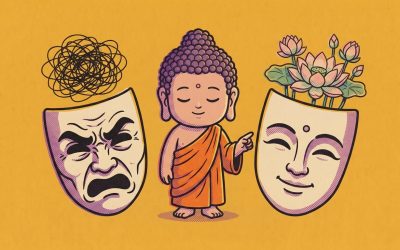
We often hear the phrase “let it go,” but in our minds, it can sound confusingly similar to “give up.” One path seems to promise freedom and peace, while the other feels like a continuation of struggle, a surrender to defeat. This confusion is common, but the distinction between these two concepts is one of the most vital in the Buddhist path to a more easeful life.
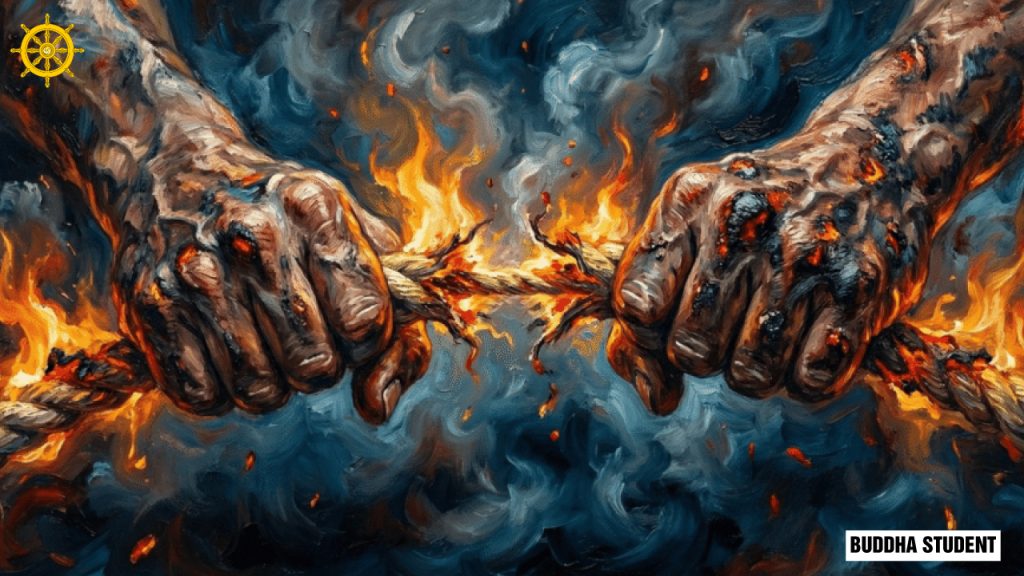
The Buddha taught that attachment is like “holding a burning rope.” The longer you grip it, the more it sears your flesh. From this perspective, letting go isn’t an act of angry resignation, where you throw the rope away in frustration. It is a moment of wisdom and self-compassion. It is simply choosing to open your hand because you finally recognize that the rope is burning you.
This document will clarify this vital distinction using timeless Buddhist wisdom and stories. By exploring the difference between release and resignation, we can learn to find more ease, clarity, and freedom in our own lives. Let’s begin by defining these two very different approaches to life’s challenges.
Release vs. Resignation
What is ‘Letting Go’?
In Buddhism, letting go is an active, wise, and compassionate act of release. It is not passivity but a courageous choice rooted in a deep understanding of reality.
- It is a form of non-attachment (Anupadana), which means appreciating life fully—its joys and its sorrows—without clinging to the past or anxiously grasping for a specific future.
- It is an active choice that requires viriya—a courageous and persistent energy, a quiet strength, and a steady resolve to stop fighting against the truth of the present moment.
- As the Zen Master Thich Nhat Hanh taught, “Letting go gives us freedom, and freedom is the only condition for happiness.” It is the recognition that our inner peace does not have to depend on external conditions.
What is ‘Giving Up’?
Giving up is a form of passive resignation, often rooted in aversion, frustration, or a sense of defeat. It is not a release from suffering but a collapse into it.
- It is still a form of attachment. When we “give up,” we are often still clinging to the desire for a different outcome, but we feel hopeless about our ability to achieve it. The struggle continues internally.
- It is a reaction, not a conscious choice. It can manifest as collapsing into laziness or deciding to continue a cycle of unhappiness out of sheer frustration, collapsing with a sense of “what’s the use?”
Core Distinctions at a Glance
The following table highlights the fundamental differences between these two mindsets.
| Letting Go (Active Release) | Giving Up (Passive Resignation) |
| Mindset: An active choice based on wisdom and compassion. Realizing you don’t need a specific outcome to be at peace. | Mindset: A reaction based on frustration or hopelessness. Realizing you won’t get the outcome you are attached to. |
| Motivation: The desire for freedom from suffering. Surrendering to the truth of the present moment. | Motivation: The desire to escape unpleasant feelings (aversion), which is another form of craving. |
| Relationship to Effort: Skillful, balanced effort (the “Middle Way”). Like tuning an instrument—not too tight, not too loose. | Relationship to Effort: Either ceasing effort out of defeat or engaging in excessive, draining striving that leads to burnout. |
| Outcome: Inner peace, clarity, freedom, and greater resilience. | Outcome: Lingering resentment, bitterness, and a sense of unresolved attachment and suffering. |
These definitions provide a framework, but the difference is best understood through story. A classic Buddhist parable perfectly illustrates how these two mindsets manifest in our lives.
A Tale of Two Monks: Seeing the Difference in Practice
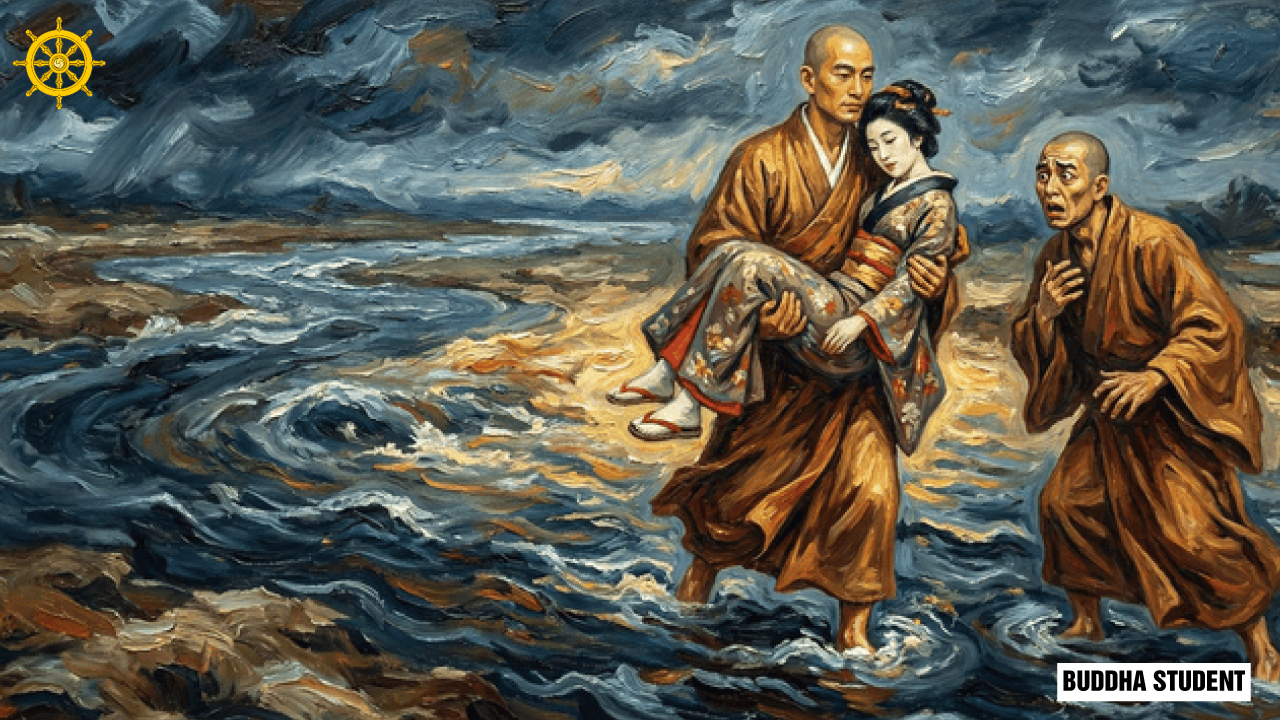
The story about letting go: the monk carrying the girl across the river
A senior monk and a junior monk were traveling together and came to a river with a strong current. At the river’s edge, a young woman was waiting, unable to cross on her own. Without a word, the senior monk picked her up, carried her across the river, and set her down gently on the other side. She went on her way, and the monks continued their journey.
For hours, the junior monk was visibly troubled, stewing in silence. Finally, unable to contain himself any longer, he burst out, “Brother, our vows strictly forbid us to have any contact with women! How could you carry that woman across the river? You have broken your vows!”
The senior monk looked at him calmly and replied, “I set her down hours ago at the river’s edge. Are you still carrying her?”
This simple story reveals the profound difference between acting in the moment and clinging to the past.
- The Senior Monk (Letting Go): He acted with compassion and then immediately let go of the event. He saw a need, responded skillfully, and then returned his full attention to the present moment. He was free from the burden of the past because he never picked it up.
- The Junior Monk (Holding On): Though he was physically miles from the river, he was still mentally carrying the woman. His suffering came from clinging to a rigid interpretation of the rules over the spontaneous compassion of the moment. This mental burden was the source of his inner turmoil, demonstrating how we can suffer long after an event has ended.
The burden carried by the junior monk is a direct result of what Buddhism identifies as the primary cause of our suffering: attachment.
Why We Suffer: The Cost of Holding On
The Buddha taught that the root cause of suffering is Upadana—a term that translates to attachment, clinging, or craving. Most of our pain comes not from life’s events themselves, but from the gap between knowing something in our minds and truly seeing it in our hearts. We may intellectually accept that life is impermanent, but our suffering comes from a failure to realize this truth on a deeper level. It is this gap that causes our internal resistance—our clinging to how we think things should be, rather than accepting them as they are.
This clinging takes many forms in our daily lives. Here are three of the most common:
- Holding onto past events and old stories: We replay arguments, second-guess decisions, and rehearse conversations from years ago, allowing the ghosts of the past to define our present reality.
- Clinging to outcomes: We create immense anxiety by believing that if we just worry, plan, and control enough, we can force life to go our way.
- Needing to be understood: We exhaust ourselves trying to justify our choices and make others see our perspective, creating suffering from a need for external validation.
This habit of holding on is deeply ingrained, but letting go is a skill—one that can be cultivated with practice.
How to Practice Letting Go: A Path to Inner Freedom
Letting go is not something you can achieve through force. As one Buddhist teaching points out, you cannot fight craving with more craving. Instead, it is a skill that emerges from the gentle and consistent practices of mindfulness and equanimity.
Step 1: The Foundation of Mindfulness (Sati)
Mindfulness is the simple yet profound practice of arriving fully in the present moment. It involves observing your thoughts, emotions, and bodily sensations as they arise, without judgment or attachment. It is the act of seeing what is here right now, clearly and kindly.
Step 2: The Wisdom of Equanimity (Upeksha)
Equanimity is a “spacious acceptance” of whatever arises in your mind and in the world. It is the ability to meet pleasant and unpleasant experiences with a balanced and peaceful heart. This does not mean becoming unfeeling. Rather, it is the cultivation of a wise and intelligent relationship with our feelings, allowing us to experience both pleasant and unpleasant sensations without being controlled by them.
The practice is not to fight the storms of emotion but to change your relationship to them. You learn to be the sky, not the storm. You can watch the clouds of thought and emotion pass through the vast sky of your awareness without believing that you are the clouds.
Step 3: A Simple Practice to Start Now
This practice can be done anytime you feel overwhelmed by a difficult thought or emotion.
- Pause: When a difficult thought or emotion arises, simply stop what you are doing.
- Breathe: Take a conscious breath, feeling the air enter and leave your body.
- Feel: Notice where the emotion lives in your body. Is there a tightness in your chest? A knot in your stomach? Tension in your shoulders?
- Acknowledge: Gently name the feeling without judgment: “This is anxiety. This is sadness.” This simple act of naming creates space between you and the emotion.
- Return: Gently bring your attention back to the sensation of your breath and the reality of the present moment.
These practices are simple, but they are not always easy. As we begin to cultivate this skill, many questions naturally arise.
Common Questions and Wise Answers
Here are some common questions about letting go, along with answers drawn from Buddhist wisdom.
Does letting go mean I become passive or stop caring?
Is non-attachment the same as being cold and emotionally detached from others?
He taught that true love is made of four essential qualities, which cannot exist when we are clinging:
Maitri (Loving-Kindness): This is the intention and capacity to offer joy and happiness. It requires listening deeply to understand what another person truly needs, rather than offering what our ego wants to give.
Karuna (Compassion): This is the ability to share in the suffering of others to lighten their burden. It is a deep involvement in another’s pain, not a detached observation of it.
Mudita (Joy): This is selfless joy in the happiness of others. When we are free from attachment, we can celebrate another’s good fortune without any sense of competition or wanting it for ourselves.
Upeksha (Equanimity): This is the “letting go” aspect of love—a spacious, non-possessive acceptance. It means loving someone without trying to put them in your pocket. You see the whole picture, not just your side of it, allowing both yourself and the other person the freedom to be.
When you let go of clinging, what remains is not a void, but the presence of these four profound qualities. This is the foundation of true love.
Is it okay to feel happy if others are suffering?
Conclusion: The Freedom of an Open Hand
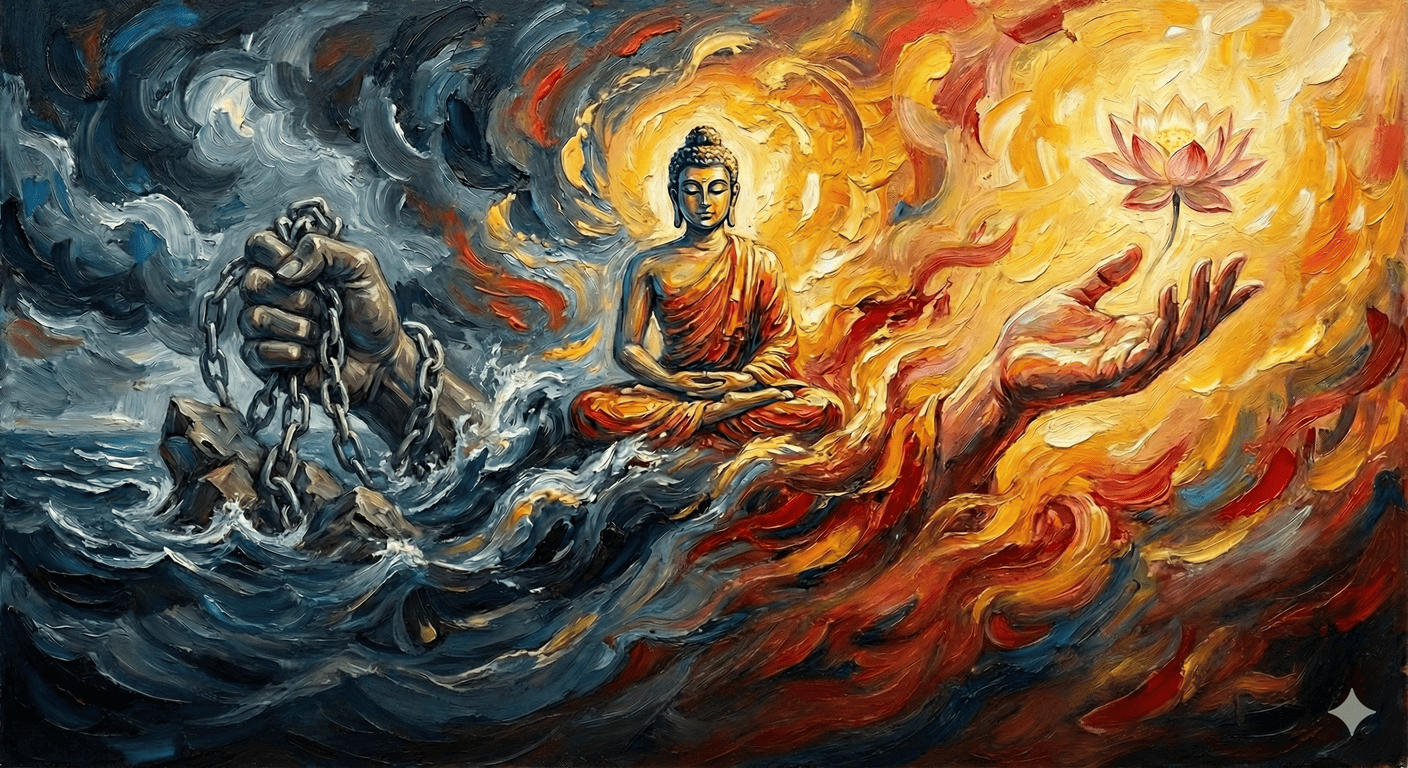
Giving up is a clenched fist of defeat and frustration, a sign that we are still attached to a fight we feel we have lost. Letting go, however, is an open hand of freedom and acceptance. It is the recognition that peace is not found in winning the struggle, but in realizing we no longer need to struggle.
Ultimately, letting go is not a loss of something valuable. It is a “return to yourself”—a return to the spacious, peaceful awareness that was there all along, underneath the layers of clinging and striving.
“Letting go gives us freedom, and freedom is the only condition for happiness. If, in our heart, we still cling to anything – anger, anxiety, or possessions – we cannot be free.” – Thich Nhat Hanh