Have you ever asked yourself, “If I were thirsty, would I drink seawater?”
It sounds absurd, yet in many ways, most of us are doing exactly that every day.
In Buddhism, there is a concept called Taṇhā (craving). It is more than ordinary desire. It is a special kind of thirst—one that grows stronger the more we try to satisfy it.
In the early Buddhist scriptures, craving is not described as merely a psychological state. It is identified as the very force that keeps beings trapped in the cycle of rebirth and suffering. The Buddha made this clear in the Four Noble Truths, where craving is pointed out as the root cause of all suffering.
And this was no minor teaching. In the Dhammapada, the Buddha devoted an entire chapter—verses 334 to 359—to the subject of craving. This is significant. It shows that if we do not truly understand craving, we cannot fully understand suffering. And if we do not learn how to work with and overcome craving, then the path to the end of suffering will remain nothing more than a theory.
Imagine you are desperately thirsty, and the only thing in front of you is seawater.
The first sip brings a sense of relief. The second sip convinces you that your thirst is being quenched. But the more you drink, the more salt enters your body, causing you to become even more dehydrated.
Your thirst does not diminish—it grows stronger. And as it intensifies, it drives you to drink even more. Eventually, you are no longer drinking because you want to. You are drinking because you can no longer stop.
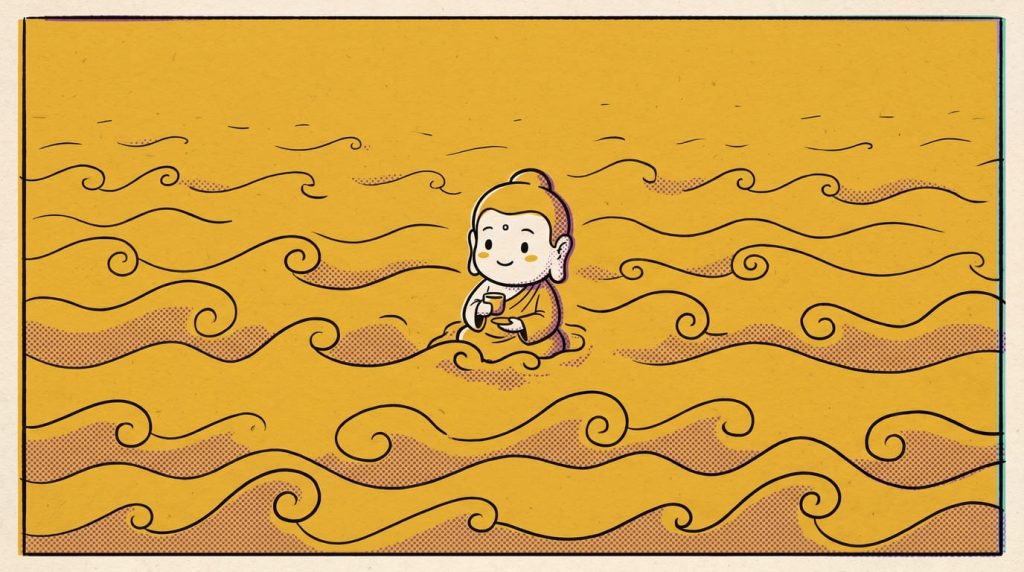
Craving is like drinking seawater—the more you drink, the thirstier you become. You cannot quench thirst with something that makes you even thirstier. In the same way, you cannot end one craving by feeding it with another.
Craving in everyday life works in much the same way.
We believe we are searching for happiness, but in reality, we are often just trying to soothe one temporary thirst after another. The price we pay is a thirst that keeps growing stronger.
In the teaching of the Twelve Links of Dependent Origination, the Buddha explained that we are not carried through the cycle of rebirth by an external force, nor by a creator. Rather, it is our own desires, rooted in ignorance, that keep the cycle turning.
Each time a thought arises—the desire to acquire something, to become something, or to avoid something—we take another step deeper into the endless cycle of birth and death. We are not being dragged along against our will. Instead, craving quietly guides our actions, shaping our lives again and again, from one existence to the next.
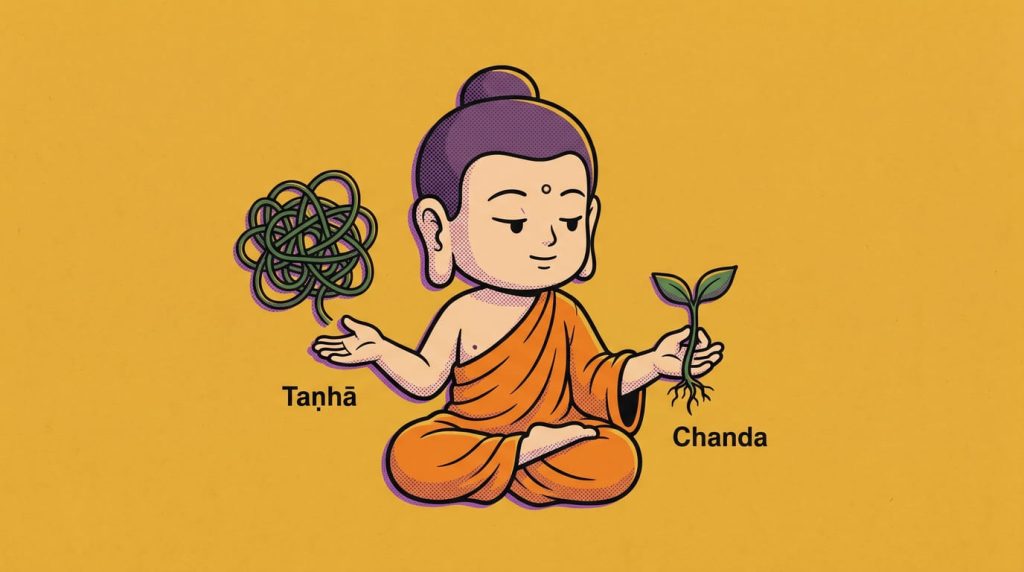
How Is Craving (Taṇhā) Different from Wholesome Aspiration (Chanda)?
One of the most common misconceptions about Buddhism is the belief that the Buddha taught people to give up all desires. Because of this misunderstanding, many people feel confused: if we are not supposed to want anything, why is it still okay to want to learn, grow as a person, live a better life, or practice meditation to reduce suffering?
In reality, Buddhism does not reject all forms of desire. In the Pāli Canon, the Buddha made a clear distinction between two very different mental states: Taṇhā (craving) and Chanda (wholesome aspiration or skillful desire). Understanding the difference between these two concepts is essential to understanding the Buddha’s teaching on the causes of suffering.
Taṇhā is commonly translated as craving, thirst, or sensual desire. It is not merely an ordinary wish. Rather, it is a compulsive longing that constantly pushes us to seek more, acquire more, and hold on more tightly, while never truly feeling satisfied. Throughout the Pāli scriptures, Taṇhā is identified as a direct cause of attachment, dissatisfaction, and suffering. It is like a thirst that can never be fully quenched: the more we try to satisfy it, the more new forms of longing arise.
In contrast, Chanda refers to wholesome intention, healthy enthusiasm, or skillful motivation directed toward beneficial goals. When someone wants to learn new knowledge, help others, cultivate ethical conduct, or practice meditation to develop wisdom, that is an expression of Chanda. Unlike craving, Chanda does not arise from a sense of lack or attachment. It arises from understanding, purpose, and conscious choice.
For this reason, when Buddhism speaks about letting go of desire, it does not mean abandoning all motivation, ambition, or positive goals. What must be recognized and transformed is Taṇhā—the craving and attachment that keep the mind restless and dissatisfied. Chanda, on the other hand, is something to be cultivated because it provides the motivation for learning, personal growth, and spiritual practice.
The difference between these two states can be observed clearly in everyday life.
Consider the way many people use their smartphones. After scrolling through social media for a long time, a person may put the phone down, only to feel restless a few minutes later and compelled to pick it up again for no particular reason. That feeling of “I can’t help myself” is a classic example of Taṇhā. In that moment, the behavior is no longer entirely under conscious control; it is being driven by an automatic urge.
Now imagine opening your phone to look up a piece of information you genuinely need. Once you’ve found it, you put the phone away without feeling deprived or pulled back to it. That is an example of Chanda. In this case, the phone is simply a tool serving a specific purpose, and you remain in control of your actions.
From a Buddhist perspective, the boundary between Taṇhā and Chanda is also the boundary between bondage and inner freedom. One is a state of being driven by unconscious impulses; the other is the ability to act with awareness, intention, and choice. Understanding this distinction helps us recognize what truly needs to be let go of on the path of practice, while also encouraging the wholesome motivations that support growth, wisdom, and liberation from suffering.
| Criteria | Taṇhā (Craving) | Chanda (Wholesome Aspiration) |
|---|---|---|
| Nature | Compulsive craving and attachment | Conscious desire directed toward a positive purpose |
| Motivation | Arises from a sense of lack, wanting to possess, control, or prolong pleasant experiences | Arises from understanding, goodwill, and a wish to grow |
| Mental State | Restless, driven, never quite satisfied | Calm, intentional, and free from compulsion |
| Level of Control | Easily controlled by desire | Retains the freedom to choose |
| Result | Leads to attachment, dissatisfaction, and suffering | Supports learning, practice, and personal development |
| Smartphone Example | Putting the phone down, then immediately feeling compelled to pick it up again for no clear reason | Using the phone to find needed information, then putting it away when finished |
| Spiritual Practice Example | Wanting special experiences or achievements to satisfy the ego | Practicing to gain understanding and reduce suffering |
| The Buddha’s View | Should be recognized and let go of | Should be cultivated and developed |
A simple way to remember the difference:
Taṇhā: “I have to have it.”
Chanda: “I want to do this because it is beneficial.”
Or even more simply:
Taṇhā = Being pulled along.
Chanda = Choosing consciously.
The Three Types of Craving (Taṇhā)
In the Buddha’s first discourse, the Dhammacakkappavattana Sutta (Setting the Wheel of Dhamma in Motion), he clearly identified Taṇhā (craving) as the cause of suffering. This refers not merely to ordinary desires, but to deeply rooted patterns of attachment that drive us to constantly seek, cling to, preserve, or resist our experiences.
In the Pāli Canon, craving is divided into three primary forms: Kāma-taṇhā (craving for sense pleasures), Bhava-taṇhā(craving for becoming), and Vibhava-taṇhā (craving for non-becoming). Together, they represent three common ways the mind reacts to life: wanting to have, wanting to become, and wanting things to cease or disappear.
| Type of Craving | Core Characteristic | Psychological Root | Modern Examples |
|---|---|---|---|
| Kāma-taṇhā (Craving for Sense Pleasure) | Desire for pleasurable sensory experiences | Greed (Lobha) | Social media addiction, compulsive shopping, excessive entertainment |
| Bhava-taṇhā (Craving for Becoming) | Desire to become someone or something | Greed combined with Delusion (Moha) | Obsession with success, status, fame, or personal identity |
| Vibhava-taṇhā (Craving for Non-Becoming) | Desire to eliminate, deny, or escape unwanted experiences | Aversion (Dosa) | Escaping reality, self-hatred, wishing problems would simply disappear |
Put simply:
- Kāma-taṇhā wants more to enjoy.
- Bhava-taṇhā wants to become someone or something. (Eternalist tendency)
- Vibhava-taṇhā wants things to stop existing or disappear. (Annihilationist tendency)
Or even more simply:
- “I want to have.” → Kāma-taṇhā
- “I want to become.” → Bhava-taṇhā
- “I want this to be gone.” → Vibhava-taṇhā
According to the Buddha, these three forms of craving keep the cycle of suffering in motion. Although they appear different on the surface, they all arise from the same underlying misunderstanding of reality and the same tendency to cling to experience rather than understand it.
Kāma-taṇhā: The Craving for Sense Pleasure
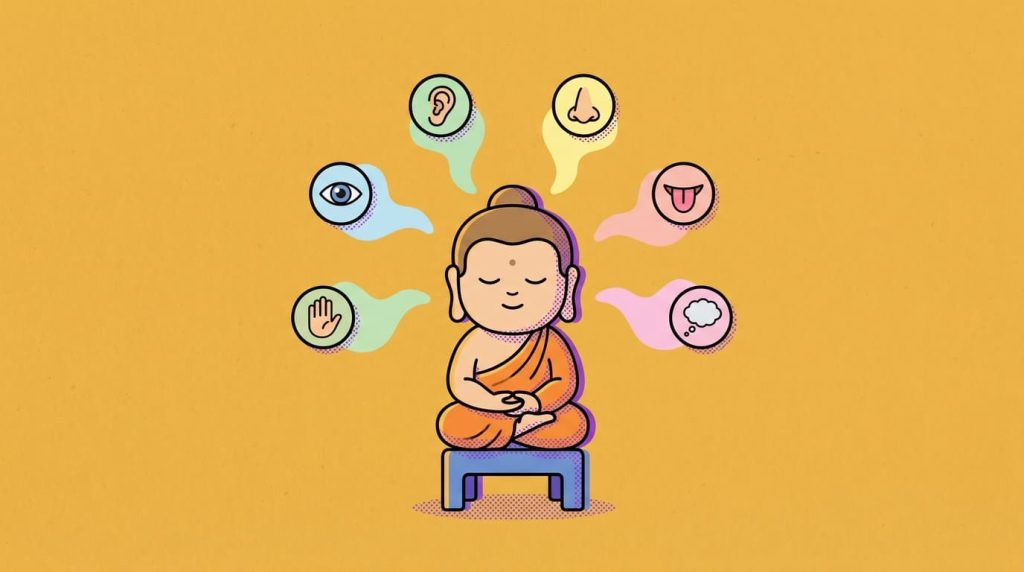
Kāma-taṇhā, or craving for sense pleasure, is the most obvious and easily recognized form of craving. It is the thirst for pleasant experiences through the six senses: wanting to see beautiful sights, hear pleasing sounds, enjoy delicious food, experience physical comfort, or indulge in thoughts that bring enjoyment and satisfaction.
What is particularly interesting is that the mind does not respond only to pleasure that is happening right now. It also revisits pleasures from the past and fantasizes about pleasures that have not yet occurred. In doing so, it continues to fuel craving—sometimes even more intensely than the actual experience itself.
A person may eat more food not because they are still hungry, but because they want to recapture the pleasure of the first few bites. In the same way, many people continue scrolling through social media not because they are receiving real value, but because they are anticipating that the next swipe might reveal something exciting.
Modern neuroscience offers an interesting parallel. Research suggests that dopamine activity is often strongest during the anticipation of a reward rather than during the reward itself. This helps explain why pleasure-seeking behaviors can become self-reinforcing loops that are difficult to break.
This is also one reason social media can be more addictive than reading a book. The feeling of “I wonder what’s coming next” continually activates the brain’s reward-seeking system, encouraging us to keep scrolling.
In the Buddhist teachings, the Buddha referred to this attractive quality as the “sweetness” (Assāda) of an experience. When the mind sees only the sweetness while overlooking its drawbacks (Ādīnava) and its impermanent nature, craving gradually takes control of our thoughts and actions.
The problem, from the Buddhist perspective, is not pleasure itself. The problem begins when the mind becomes attached to pleasure, depends on it for happiness, and continually seeks more of it. At that point, enjoyment turns into craving, and craving becomes a source of suffering.
Bhava-taṇhā: The Craving to Become
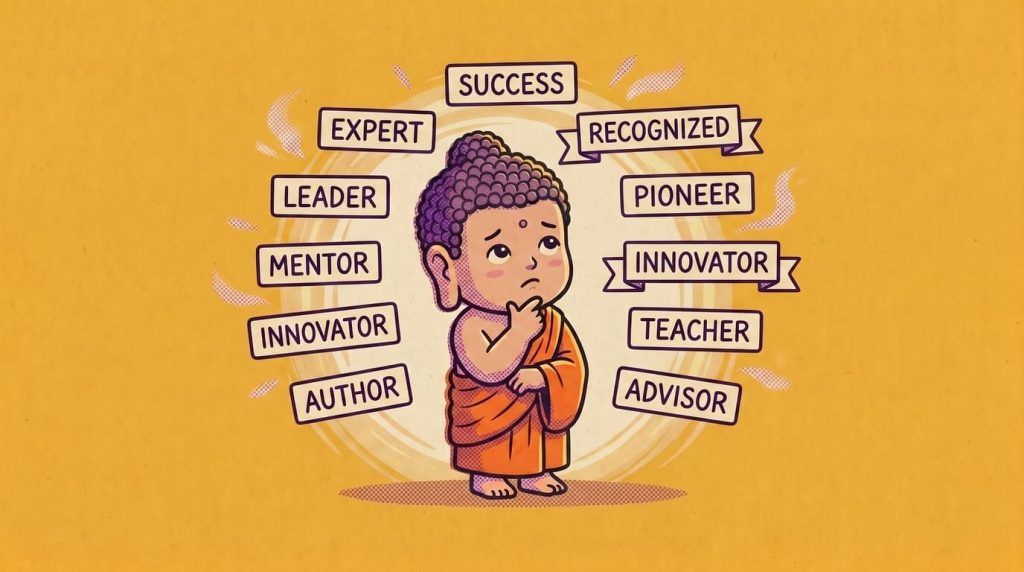
If Kāma-taṇhā is the desire to have, then Bhava-taṇhā is the desire to become.
This is the tendency to build, strengthen, and protect a personal identity. People constantly strive to become more successful, more skilled, more respected, or more important. From pursuing status and recognition to wanting to become an exceptional meditator or spiritual practitioner, all of these pursuits can carry the mark of Bhava-taṇhā when they are tied to a sense of self.
At its root lies the belief that there is a solid and enduring “self” that must be maintained, improved, and protected. In Buddhist thought, this is closely related to eternalism—the view that a permanent self exists and continues unchanged through time.
In modern life, Bhava-taṇhā often reveals itself through the need for validation and recognition. Consider someone who posts content on social media and then repeatedly checks for likes, comments, or shares. What is being sought is not merely interaction, but confirmation of personal worth and identity.
From the perspective of modern psychology, this can become fertile ground for narcissistic tendencies. In many ways, social media platforms are perfectly designed to feed Bhava-taṇhā, constantly offering opportunities to construct, display, and reinforce a desired self-image.
The paradox is that Bhava-taṇhā never provides lasting fulfillment. As soon as one goal is achieved, the mind quickly creates another. A promotion leads to the desire for a higher position. Recognition leads to the desire for greater recognition. Success becomes a moving target that is never fully reached.
As a result, those caught in Bhava-taṇhā often live in a continual state of self-improvement and self-justification, feeling compelled to prove themselves over and over again, yet rarely experiencing a genuine sense of enoughness.
In Buddhist teachings, the issue is not growth, achievement, or personal development themselves. The issue arises when our happiness becomes dependent on becoming someone else, somewhere else, or something more than we are right now. When identity becomes something we must constantly defend and upgrade, the pursuit of becoming turns into another form of bondage.
Vibhava-taṇhā: The Craving for Non-Existence
In contrast to Bhava-taṇhā—the craving to become—there is Vibhava-taṇhā, the craving for non-becoming or non-existence. It is the desire to eliminate, reject, suppress, or escape what we do not like.
If Bhava-taṇhā says, “I want to become something,” then Vibhava-taṇhā says, “I want this to stop existing.”
In Buddhist teachings, this tendency is associated with annihilationism—the belief that suffering can be solved by destroying, escaping, or erasing what is unpleasant. It appears whenever we desperately want to get rid of painful emotions, reject parts of ourselves that we dislike, or escape difficult realities rather than understand them.
In extreme cases, this can manifest as self-destructive thinking or the belief that complete disappearance is the answer to all problems.
More commonly, however, Vibhava-taṇhā appears in subtle ways throughout daily life. It is present whenever the mind resists reality with thoughts such as:
- “I wish this hadn’t happened.”
- “I don’t want to feel this way.”
- “I just want this to go away.”
What is remarkable is that the more we resist an experience, the more tightly we become bound to it. Resistance does not make suffering disappear. Instead, it often prolongs and reinforces it in different forms.
At a milder level, Vibhava-taṇhā may appear as the urge to give up, withdraw, or disconnect from life in order to avoid pressure and discomfort. At a deeper level—and this deserves to be approached with compassion—it can appear as the wish to no longer exist at all.
Many people mistake this for liberation. From a Buddhist perspective, however, it is still a form of craving—simply moving in the opposite direction.
Why? Because the desire to erase oneself still revolves around attachment to the idea of a self. The mind first creates the notion of “me” and then becomes obsessed with getting rid of that “me.”
In simpler terms, you cannot destroy something that was never truly a fixed entity to begin with.
According to Buddhism, our suffering does not come from failing to destroy the self. It comes from failing to see its true nature.
What we call “I” is not a permanent, independent essence. It is a constantly changing process arising through causes and conditions—a dynamic flow of physical and mental phenomena. There is no fixed entity at its center.
When this is seen clearly, the urge to preserve the self and the urge to eliminate the self both begin to fade. The struggle itself loses its foundation.
This marks the crucial distinction between letting go and giving up.
- Letting go comes from wisdom and understanding.
- Giving up comes from aversion and escape.
One leads to genuine freedom; the other is merely another form of bondage.
For this reason, the Buddhist path is neither about chasing what we like nor destroying what we dislike. The Buddha taught that all three forms of craving—Kāma-taṇhā, Bhava-taṇhā, and Vibhava-taṇhā—arise from attachment: attachment to experiences, attachment to preferences, and ultimately attachment to the idea of a self that is having those experiences.
Freedom begins not when we get everything we want, nor when we eliminate everything we dislike, but when we see clearly the processes of craving that drive both impulses. Only then can the cycle of suffering begin to unwind.
11 Powerful Metaphors for Craving in the Pāli Canon
In Pāli, the word Taṇhā literally means “thirst.” It refers to the intense urge to grasp what is pleasant and push away what is unpleasant.
Unlike natural needs, which can be satisfied, craving has no true endpoint. It is not a problem that can be solved once and for all. Rather, it is a self-perpetuating cycle: the more it is fed, the more it demands.
Because craving is subtle and difficult to recognize directly, the Buddha frequently used vivid metaphors throughout the Pāli Canon to illustrate its nature. These images reveal how craving operates beneath the surface of everyday life and why it becomes such a powerful source of suffering.
To truly understand Taṇhā, it helps to understand these metaphors. Each one highlights a different aspect of craving—its seductive nature, its persistence, its ability to trap the mind, and the suffering that follows when we blindly obey it.
The following eleven images provide some of the most powerful ways the Buddhist scriptures describe the nature of craving. They remain remarkably relevant today, helping us recognize patterns of attachment that often go unnoticed in our own lives.
Craving as the Maluva Creeper
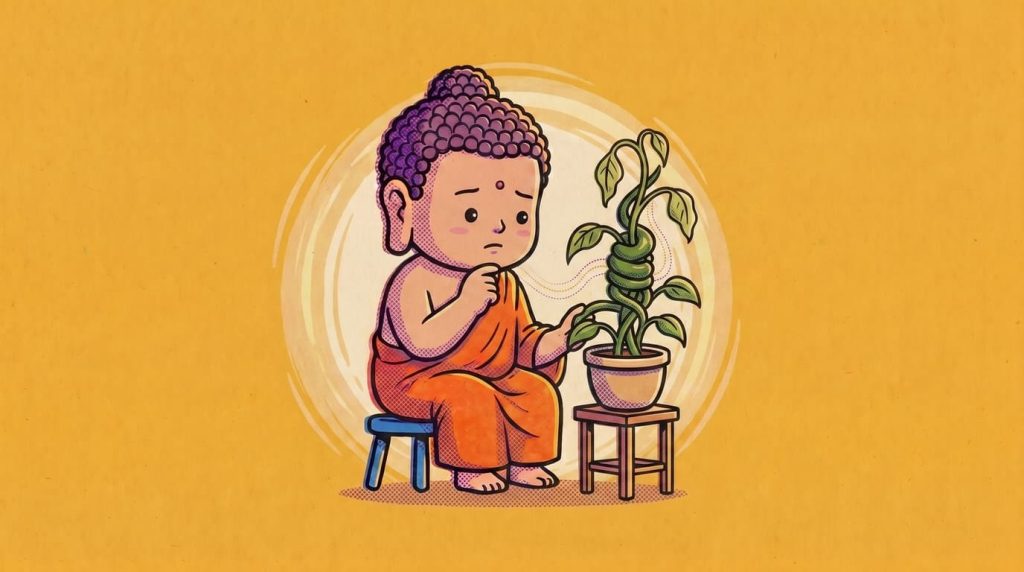
The Buddha compared craving to the Māluvā creeper, a climbing vine that slowly wraps itself around a tree.
At first, it appears as nothing more than a small and harmless shoot. It seems insignificant, hardly worth noticing. But in the absence of mindfulness and awareness, it quietly grows, spreading its tendrils and tightening its grip around its host.
Little by little, it draws strength from the very tree it clings to, eventually constricting and overwhelming it. By the time the damage becomes obvious, the tree may already be choked by the vine that once seemed so harmless.
Craving works in much the same way. A small attachment, an innocent desire, or a fleeting indulgence may appear insignificant at first. Yet when left unchecked, it gradually takes root in the mind, strengthening through repetition and habit.
What begins as a simple preference can become dependence. What begins as a passing desire can become a powerful attachment.
Like the Māluvā vine, craving rarely takes hold all at once. It grows quietly, patiently, and often unnoticed—until one day we realize how much of our thoughts, choices, and sense of well-being have become entangled in its grip.
By then, the mind is no longer simply experiencing desire; it is being shaped and directed by it. The tree of consciousness has become wrapped in the vine of craving.
Dhammapada, verse 334:
The craving of a person who lives negligently
Spreads like a creeping vine.
Such a person leaps ever onward,
Like a monkey seeking fruit in the forest.
According to the traditional commentaries, the Māluvā vine was a parasitic creeper found in India. It did not merely wrap itself around a tree—it drew nourishment from its host and could eventually strangle it with remarkable force. The Buddha used this image to illustrate how desire can grow uncontrollably when a person lives in a state of heedlessness (pamāda), lacking mindfulness and mastery over the mind.
What makes this vine truly dangerous is not that it tightens its grip, but that it does so gradually.
The host tree is not destroyed overnight. Instead, its strength is slowly drained away until the damage is so extensive that recovery becomes difficult.
Craving operates in much the same way.
It does not usually overwhelm us all at once. Rather, it feeds on our own energy, attention, and habits, quietly growing stronger while making attachment feel increasingly normal.
Over time, it spreads into every corner of the mind. We begin to accept our addictions, compulsions, emotional dependencies, and possessive desires as ordinary parts of life. What was once recognized as attachment gradually becomes woven into our identity.
By the time we finally notice the weight of our bondage, the roots of the mind may already be deeply entangled.
The vine has been borrowing our own life force to sustain itself all along.
This is one reason letting go can feel so difficult. When an attachment has been with us for years, it no longer feels like something separate from us. It feels like a part of who we are.
And so, releasing it can feel less like removing a burden and more like cutting away a piece of ourselves.
Yet from the Buddhist perspective, this feeling is precisely part of the illusion. The attachment became intertwined with our sense of self, but it was never the self. The vine may have wrapped itself tightly around the tree, but it was never the tree itself.
Freedom begins when we learn to recognize the difference.
Craving doesn’t destroy us overnight. It grows so gradually that we eventually accept it as a normal part of who we are.
Craving as the Birana Grass
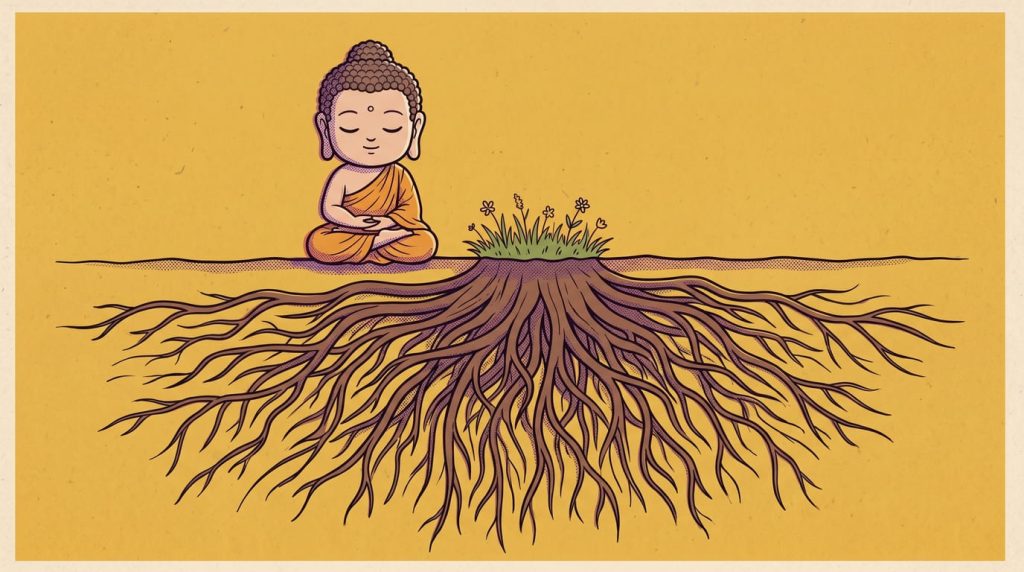
Have you ever thought you had overcome a bad habit, an attachment, or a source of suffering, only to see it return later—sometimes stronger than ever? The Buddha compared craving to the Birana grass.
Dhammapada, verses 335 and 336:
Sorrow grows
Like grass after rain
For anyone overcome by this miserable craving
And clinging to the world.
Sorrow falls away
Like drops of water from a lotus
For anyone who overcomes this miserable craving
And clinging to the world.
The significance of this image lies in the nature of the Birana grass itself. Its roots can extend deep beneath the ground, reaching far below the surface. We may easily cut away the visible growth and convince ourselves, “I’m fine now. I’ve overcome my craving. I’ve moved beyond my suffering.” But in reality, the roots remain untouched.
What appears to be freedom may simply be a dormant state—a period of waiting for the right conditions to return.
In the Buddhist teachings, these hidden roots are described as latent tendencies and fetters—underlying desires and attachments that remain buried in the mind. All they need is a little “rain”: a favorable condition, a compliment, an insult, a temptation, or an attractive object. When those conditions arise, the dormant seeds quickly sprout again.
The lesson is clear.
As long as the roots of attachment remain intact, suffering will continue to reappear in one form or another. The cycle may pause, but it has not ended.
This is why the Buddha taught that it is not enough to merely suppress craving through willpower. Temporary restraint can cut back the visible growth, but it cannot remove the roots.
What is needed is the deeper work of wisdom and mindful awareness—digging beneath the surface of the mind and seeing clearly the attachments that remain hidden there.
Only when those roots are uprooted can true freedom emerge.
Then, no matter how strong the storms of life may be, they no longer have the power to shake the mind in the same way.
And when attachment finally falls away, sorrow can leave the heart naturally and effortlessly—like a drop of water sliding from a lotus leaf.
As long as the roots remain, craving will always grow back.
The Craving Mind as a Monkey Swinging Through Trees

The Buddha likened the craving mind to a monkey in the forest. Restlessness is its nature. The moment it grabs hold of one branch, it is already reaching for the next, always chasing after fruit that seems sweeter somewhere else.
Beyond Dhammapada verse 334 mentioned earlier, Assutavā Sutta (SN 12.61), also recalls this image of craving as a monkey swinging through trees.
….But that which is called ‘mind’ and also ‘sentience’ and also ‘consciousness’ arises as one thing and ceases as another all day and all night. Note that impermanence is described as constantly changing during the day rather than in terms of momentariness, which is not found in the Suttas. It’s like a monkey moving through the forest. It grabs hold of one branch, lets it go, and grabs another; then it lets that go and grabs yet another. In the same way, that which is called ‘mind’ and also ‘sentience’ and also ‘consciousness’ arises as one thing and ceases as another all day and all night.
Craving works in exactly the same way. It never fully accepts reality as it is. Instead, it constantly jumps from one object to another, chasing new promises and new possibilities. From one thought to the next, and from one life to another, we become caught in an endless pursuit, believing that fulfillment lies somewhere outside ourselves.
It plants an illusion in the mind: “Something else will be better,” or “The next thing will be perfect.” In doing so, it robs us of the ability to be content with what we already have. As long as the monkey mind keeps swinging from branch to branch, we remain vulnerable to disappointment and dissatisfaction.
The destination of craving is never rest. It is simply the repetition of increasingly subtle forms of thirst.
And the danger of craving is not limited to restlessness alone. It also lies in its extraordinary power to bind and enslave us whenever we encounter temptation.
Craving never allows us to stand still; it constantly whispers, “somewhere else will be better.”
The danger of craving goes far beyond mere restlessness. It also lies in its frightening power to trap the mind when it encounters temptation.
The Buddha told the story of a foolish monkey that accidentally touched a patch of sticky resin in the forest. When its first hand became stuck, it panicked and used the other hand to pull itself free. That hand became stuck as well.
Desperate to escape, it pressed one foot into the resin, then the other. Finally, it used its mouth, hoping to bite its way free. But each attempt only made things worse, until its entire body was trapped in the sticky mass.

Craving and the Five-Point Sticky Trap
The Monkey Discourse (Makkaṭa Sutta SN 47.7):
“Bhikkhus, in the Himalayas, the king of mountains, there are rugged and uneven zones where neither monkeys nor human beings can go; there are rugged and uneven zones where monkeys can go but not human beings; there are even and delightful regions where both monkeys and human beings can go. There, along the monkey trails, hunters set out traps of pitch for catching monkeys.
“Those monkeys who are not foolish and frivolous, when they see the pitch, avoid it from afar. But a monkey who is foolish and frivolous approaches the pitch and seizes it with his hand; he gets caught there. Thinking, ‘I will free my hand,’ he seizes it with his other hand; he gets caught there. Thinking, ‘I will free both hands,’ he seizes it with his foot; he gets caught there. Thinking, ‘I will free both hands and my foot,’ he seizes it with his other foot; he gets caught there.’ Thinking, ‘I will free both hands and feet,’ he applies his muzzle to it; he gets caught there.
“Thus, bhikkhus, that monkey, trapped at five points, lies there screeching. He has met with calamity and disaster and the hunter can do with him as he wishes. The hunter spears him, fastens him to that same block of wood, and goes off where he wants. So it is, bhikkhus, when one strays outside one’s own resort into the domain of others.
“Therefore, bhikkhus, do not stray outside your own resort into the domain of others. Mara will gain access to those who stray outside their own resort into the domain of others; Mara will get a hold on them.
“And what is not a bhikkhu’s own resort but the domain of others? It is the five cords of sensual pleasure…. as above … This is what is not a bhikkhu’s own resort but the domain of others.
“Move in your own resort, bhikkhus, in your own ancestral domain. Mara will not gain access to those who move in their own resort, in their own ancestral domain; Mara will not get a hold on them.
“And what is a bhikkhu’s resort, his own ancestral domain? It is the four establishments of mindfulness. What four? Here, bhikkhus, a bhikkhu dwells contemplating the body in the body, ardent, clearly comprehending, mindful, having removed covetousness and displeasure in regard to the world. He dwells contemplating feelings in feelings … mind in mind … phenomena in phenomena, ardent, clearly comprehending, mindful, having removed covetousness and displeasure in regard to the world. This is a bhikkhu’s resort, his own ancestral domain.”
Craving is not merely a rope that binds us from the outside; it is more like a sticky resin that traps us from within.
Our greatest mistake is trying to cure the suffering caused by one craving with another craving. We look for escape in the very thing that keeps us trapped.
True freedom does not come from struggling harder inside the resin trap. It comes from remaining within the domain of mindfulness, so that we never reach out and touch the trap of attachment in the first place.
For example, when feeling lonely, many people rush into a relationship, only to suffer later from dependency, jealousy, or fear of loss. In other words, they use one desire to escape the suffering caused by another desire.
The result is not the end of suffering, but suffering layered upon suffering.
The more we try to remove craving with craving, the more deeply we become stuck in it.
Craving as a Consuming Fire

Moving beyond metaphors drawn from plants and animals, the Buddha used an even more powerful image to reveal the destructive nature of craving: fire.
He declared a profound and unsettling truth: “All is burning.”
The eye, ear, nose, tongue, body, and mind—and all the feelings and experiences that arise through them—are caught in a vast blaze. This is the fire of greed, hatred, and delusion.
Among these, craving serves as the fuel that keeps the flames alive. As long as we continue to accumulate and nourish our desires, the fire of suffering will continue to feed upon them, consuming our inner peace.
We are not merely standing beside the fire.
We ourselves are burning from within.
Ādittapariyāya Sutta (SN 35.28)
At one time the Buddha was staying near Gayā on Gayā Head together with a thousand mendicants. There the Buddha addressed the mendicants:
“Mendicants, all is burning. And what is the all that is burning?
The eye is burning. Sights are burning. Eye consciousness is burning. Eye contact is burning. The painful, pleasant, or neutral feeling that arises dependent on eye contact is also burning. Burning with what? Burning with the fires of greed, hate, and delusion. Burning with rebirth, old age, and death, with sorrow, lamentation, pain, sadness, and distress.
The ear … nose … tongue … body …
The mind is burning. Ideas are burning. Mind consciousness is burning. Mind contact is burning. The painful, pleasant, or neutral feeling that arises dependent on mind contact is also burning. Burning with what? Burning with the fires of greed, hate, and delusion. Burning with rebirth, old age, and death, with sorrow, lamentation, pain, sadness, and distress, I say.
Seeing this, a learned noble disciple grows disillusioned with the eye, sights, eye consciousness, and eye contact. And they grow disillusioned with the painful, pleasant, or neutral feeling that arises dependent on eye contact.
They grow disillusioned with the ear … nose … tongue … body … mind … painful, pleasant, or neutral feeling that arises dependent on mind contact.
Being disillusioned, desire fades away. When desire fades away they’re freed. When they’re freed, they know they’re freed.
They understand: ‘Rebirth is ended, the spiritual journey has been completed, what had to be done has been done, there is nothing further for this place.’”
That is what the Buddha said. Satisfied, the mendicants approved what the Buddha said. And while this discourse was being spoken, the minds of the thousand mendicants were freed from defilements by not grasping.
Do you see it?
Our six senses—and all the pleasant, unpleasant, and neutral feelings that arise through them—are immersed in a great fire.
And within that fire, craving serves as an endless source of fuel.
As long as we continue to accumulate and nourish our desires, the flames of suffering will keep being fed, burning away our inner peace.
We keep throwing more “firewood” into the mind—more objects of pleasure, more things to possess, more experiences to chase—and then wonder why we remain agitated, restless, and dissatisfied.
In this same discourse, the Buddha also pointed to the way the fire can be extinguished. Not by searching for a cooler flame, but by developing nibbidā—often translated as disenchantment.
This disenchantment is not pessimism, depression, or the weariness of someone defeated by life. Rather, it is the awakening of wisdom that comes from seeing things as they truly are.
A wise person becomes disenchanted not because life has failed them, but because they clearly see the nature of the fire: it burns, it hurts, and it consumes.
When you truly grow weary of setting yourself on fire, virāga—the fading of craving and attachment—arises naturally.
As long as the fuel of craving remains, the fire of suffering will never be extinguished.
Craving as a Seamstress
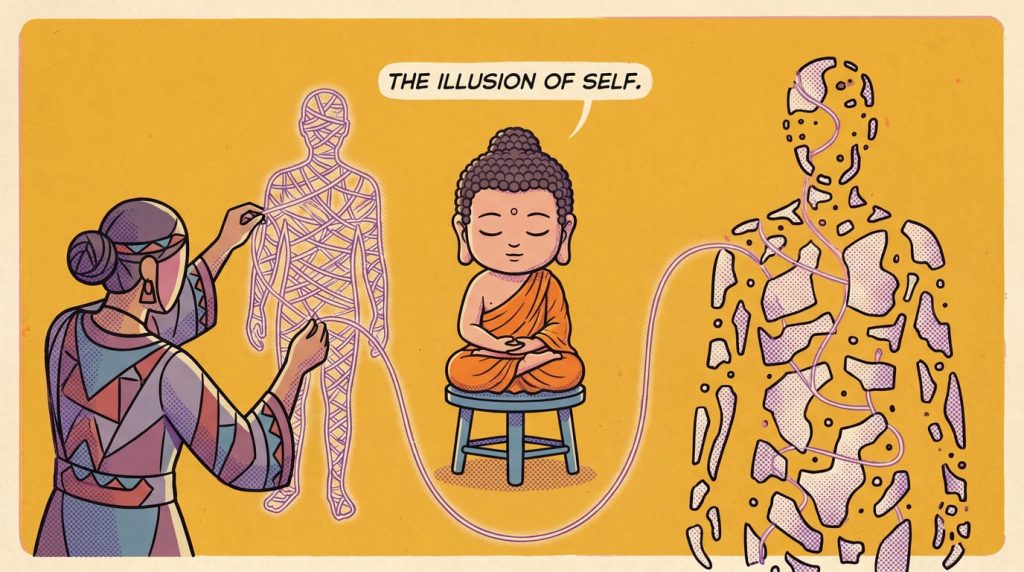
Perhaps the most subtle and profound metaphor of all is the Buddha’s comparison of craving to a seamstress or tailor (Taṇhā Sibbanī).
Quietly and tirelessly, this tailor stitches together the scattered fragments of experience—memories of the past, feelings of the present, and fantasies about the future—creating what appears to be a continuous thread of consciousness.
It is this ongoing stitching that deceives us into believing in the existence of a stable, enduring, and consistent “self” moving through time.
In reality, what we take to be a permanent “I” is often nothing more than an illusion of continuity, woven together by the needle and thread of craving.
The Buddha pointed out that if this tailor were to stop sewing—if the thread of craving were cut—the entire fabric of selfhood and the cycle of becoming would begin to unravel on its own.
The garment of ego, carefully stitched together over countless moments of attachment, would fall apart, revealing a reality that is free from the illusion of a permanent self.
What remains is not annihilation, but freedom: a direct recognition that the self we spent so much effort defending and constructing was never a fixed entity in the first place. It was a story continuously sewn together by craving. When the sewing stops, the illusion no longer holds.
Majjhesutta AN 6.61 – Numbered Discourses 6.61 6. The Great Chapter In the Middle:
So I have heard. At one time the Buddha was staying near Varanasi, in the deer park at Isipatana.
Now at that time, after the meal, on return from almsround, several senior mendicants sat together in the pavilion and this discussion came up among them, “Reverends, this was said by the Buddha in ‘The Way to the Far Shore’, in ‘The Questions of Metteyya’:
‘The thoughtful one who has known both ends, and is not stuck in the middle: he is a great man, I declare, he has escaped the seamstress here.’
But what is one end? What’s the second end? What’s the middle? And who is the seamstress?” When this was said, one of the mendicants said to the senior mendicants:
“Contact, reverends, is one end. The origin of contact is the second end. The cessation of contact is the middle. And craving is the seamstress, for craving weaves one to being regenerated in one state of existence or another. That’s how a mendicant directly knows what should be directly known and completely understands what should be completely understood. Knowing and understanding thus they make an end of suffering in this very life.”
When this was said, one of the mendicants said to the senior mendicants:
“The past, reverends, is one end. The future is the second end. The present is the middle. And craving is the seamstress … That’s how a mendicant directly knows … an end of suffering in this very life.”
When this was said, one of the mendicants said to the senior mendicants:
“Pleasant feeling, reverends, is one end. Painful feeling is the second end. Neutral feeling is the middle. And craving is the seamstress … That’s how a mendicant directly knows … an end of suffering in this very life.”
When this was said, one of the mendicants said to the senior mendicants:
“Name, reverends, is one end. Form is the second end. Consciousness is the middle. And craving is the seamstress … That’s how a mendicant directly knows … an end of suffering in this very life.”
When this was said, one of the mendicants said to the senior mendicants:
“The six interior sense fields, reverends, are one end. The six exterior sense fields are the second end. Consciousness is the middle. And craving is the seamstress … That’s how a mendicant directly knows … an end of suffering in this very life.”
When this was said, one of the mendicants said to the senior mendicants:
“Substantial reality, reverends, is one end. The origin of substantial reality is the second end. The cessation of substantial reality is the middle. And craving is the seamstress, for craving weaves one to being regenerated in one state of existence or another. That’s how a mendicant directly knows what should be directly known and completely understands what should be completely understood. Knowing and understanding thus they make an end of suffering in this very life.”
When this was said, one of the mendicants said to the senior mendicants:
“Each of us has spoken from the heart. Come, reverends, let’s go to the Buddha, and inform him about this. As he answers, so we’ll remember it.”
“Yes, reverend,” those senior mendicants replied. Then those senior mendicants went up to the Buddha, bowed, sat down to one side, and informed the Buddha of all they had discussed. They asked, “Sir, who has spoken well?”
“Mendicants, you’ve all spoken well in a way. However, this is what I was referring to in ‘The Way to the Far Shore’, in ‘The Questions of Metteyya’ when I said:
‘The sage has known both ends, and is not stuck in the middle. He is a great man, I declare, he has escaped the seamstress here.’
Listen and apply your mind well, I will speak.”
“Yes, sir,” they replied. The Buddha said this:
“Contact, mendicants, is one end. The origin of contact is the second end. The cessation of contact is the middle. And craving is the seamstress, for craving weaves one to being regenerated in one state of existence or another. That’s how a mendicant directly knows what should be directly known and completely understands what should be completely understood. Knowing and understanding thus they make an end of suffering in this very life.”
The “self” that exhausts us to protect is, in many ways, an illusion of continuity—something woven together by the needle and thread of craving.
We are not imprisoned inside a solid, unchanging entity. Rather, we bind ourselves through an ongoing process of stitching together one desire after another. When that stitching comes to an end, the garment of selfhood naturally unravels, and that is when genuine freedom becomes possible.
Put simply, whenever we encounter life—through seeing, hearing, or experiencing something—a feeling arises. If we do not cling to it, that feeling simply comes and goes. The problem begins when liking or disliking appears, when the mind starts wanting more of what is pleasant or wanting to get rid of what is unpleasant.
That wanting is like a tailor at work. It takes a simple feeling and begins weaving stories, attachments, expectations, and identities around it. Eventually, suffering follows.
From this perspective, it is not circumstances themselves that cause our suffering. More often, it is our attachment to feelings and the stories we build around them.
We are not trapped inside some rigid cage. We are continually tying the knots ourselves through an endless process of craving.
From one pleasant feeling to another painful one, from memories of the past to fantasies about the future, the tailor of craving never stops sewing. Stitch by stitch, it creates the appearance of a coherent and enduring self.
Yet the Buddha pointed out that if the tailor stops sewing—if the thread of craving is cut—the entire garment of ego and the cycle of becoming begin to unravel by themselves.
This is not a loss. It is a revelation.
What falls away is not something real and permanent, but an illusion that was being constantly maintained. What remains is a reality that is free, open, and not centered around a fixed self.
When the stitching stops, the garment of selfhood dissolves.
And that is the moment when true freedom can finally be touched.
The ‘I’ we strive to hold onto… may be nothing more than a thread continuously sewn by craving.
We Are Trapped in Craving Like a Hare in a Snare, a Spider in Its Web, and Fish in a Drying Pond
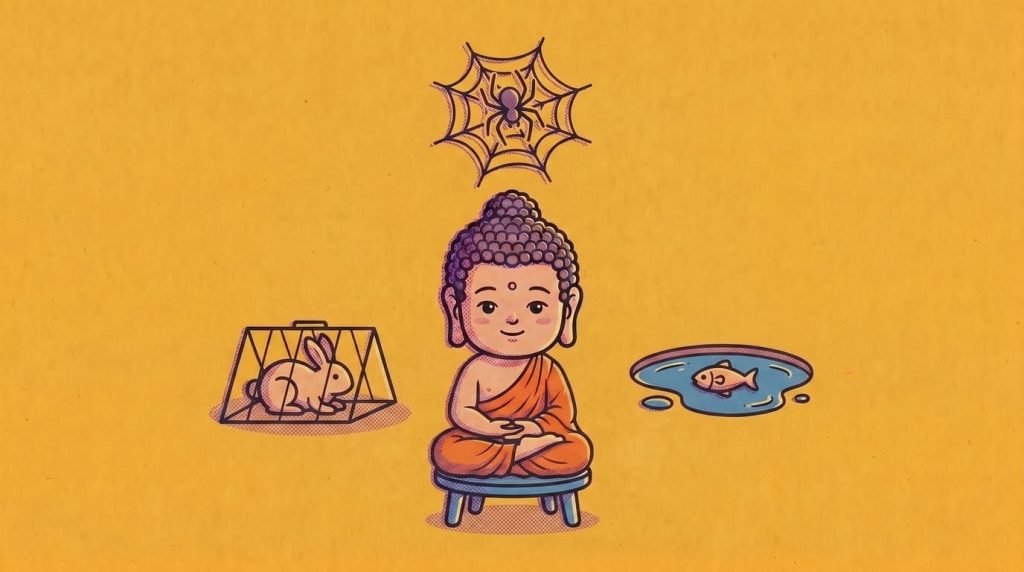
The Buddha used a series of striking and unsettling images to illustrate the condition of beings under the power of craving.
We are like a rabbit caught in a snare. The more it panics and struggles to escape, the tighter the trap closes around it. In the same way, our frantic attempts to satisfy craving often deepen the very bondage we are trying to escape.
We are also like a spider that tirelessly spins its own web. Thread by thread, it creates a network of desires, attachments, and ambitions—only to become trapped within the structure it has woven itself.
Yet perhaps the most tragic image is that of fish stranded in a shrinking pool of water. As their source of survival gradually dries up, they turn against one another, driven by fear, desperation, and the instinct to cling to what remains. Likewise, when the objects of our desires become scarce or threatened, craving can give rise to conflict, competition, and hostility.
Together, these three metaphors offer a powerful warning.
Craving turns us into victims of circumstances, prisoners of our own making, and adversaries of one another in a struggle that can never bring lasting fulfillment.
Dhammapada, verses 342 and 343:
Surrounded by craving,
People run around like frightened hares.
Held by fetters and bonds,
They suffer, repeatedly, over a long time.
Surrounded by craving,
People run around like frightened hares.
Seeking dispassion,
A monastic should dispel craving.
Dhammapada, verse 347
Those who are infatuated with lust
Fall back into the self-created stream,
As a spider falls into its own web.
The wise, having cut this asunder,
Wander on, free from longing,
Relinquishing all suffering
Anthology of Discourses 4.15 Taking Up Arms – Attadaṇḍasutta snp 4.15
Peril stems from those who take up arms—just look how people conflict! I shall extol how I came to be stirred with a sense of urgency.
I saw this population flounder, like a fish in a little puddle. Seeing them at odds with each other, fear came upon me.
The world around was volatile, all directions were in turmoil. Wanting a home for myself, I saw nowhere unsettled. Osita (and osāna in the next line) convey both “occupy” and “end” in the sense of a place of rest at the end of a journey.
Yet even in their settlement they were at odds—Here, tveva has a contrastive sense. seeing that, I grew uneasy. Then I saw a dart there, so hard to see, stuck in the heart.
When struck by that dart, you run around in all directions. But when that same dart has been plucked out, you neither run around nor sink down.
(On that topic, the trainings are recited.) Agreeing with Norman that this line is likely a reciter’s remark. However, I take tattha as the locative of reference. “That topic” is the extraction of the dart, for which the remainder of the sutta gives practical guidelines. Whatever attachments there are in the world, don’t pursue them. Having pierced through sensual pleasures in every way, train yourself for extinguishment.
Be truthful, not rude, free of deceit, and rid of slander; without anger, a sage would cross over the evils of greed and avarice.
Prevail over sleepiness, sloth, and drowsiness, don’t abide in negligence, A person intent on quenching would not stand for arrogance.
Don’t be led into lying, or get caught up in affection for form. Completely understand conceit, and desist from hasty conduct.
Don’t relish the old, or welcome the new. Don’t grieve for what is running out, or get attached to things that pull you in.
Greed, I say, is the great flood, and longing is the current—the basis, the compulsion, the swamp of sensuality so hard to get past.
The sage never strays from the truth; the brahmin stands on solid ground. Having given up everything, they are said to be at peace.
They have truly known, they’re a knowledge master, understanding the teaching, they are independent. They rightly proceed in the world, not coveting anything here.
One who has crossed over sensuality here, the chain in the world so hard to get past, grieves not, nor hopes; they’ve cut the strings, they’re no longer bound.
What came before, let wither away, and after, let there be nothing. If you don’t grasp at the middle, you will live at peace.
One who has no sense of ownership in the whole realm of name and form, does not grieve for that which is not, they suffer no loss in the world.
If you don’t think of anything as belonging to yourself or others, not finding anything to be ‘mine’, you won’t grieve, thinking ‘I don’t have it’.
Not bitter, not fawning, unstirred, everywhere even; when asked about one who is unwavering, I declare that that is the benefit.
For the unstirred who understand, there’s no performance of deeds. Desisting from instigation, they see sanctuary everywhere.
A sage doesn’t speak of themselves as being among superiors, inferiors, or equals. Peaceful, rid of stinginess, they are neither ditching nor taking up.
These three images serve as a warning: craving turns us into victims of circumstances (like the rabbit), prisoners of our own making (like the spider), and adversaries of one another (like the fish).
Freedom does not come from finding a looser trap or a larger pond. Every trap remains a trap, and every pond will eventually dry up.
Instead, the Buddha taught a way of living rooted in peace and wisdom:
What came before, let wither away,
and after, let there be nothing.
If you don’t grasp at the middle,
you will live at peace.
or
Don’t relish the old,
or welcome the new.
Don’t grieve for what is running out,
or get attached to things that pull you in.
Don’t keep replaying the past in your mind. Don’t spend your life worrying about the future either. And don’t cling to what’s happening right now as if it has to stay forever. When you stop chasing, resisting, and holding on, your mind naturally becomes more peaceful.
When you no longer see anything as “mine” to cling to, you will no longer see anything as yours to lose. That is the moment the fish leaves the shrinking pool behind and returns to the vast ocean of freedom.
Blind reaction does not free us; it only tightens the grip of suffering.
Craving as the Second Arrow
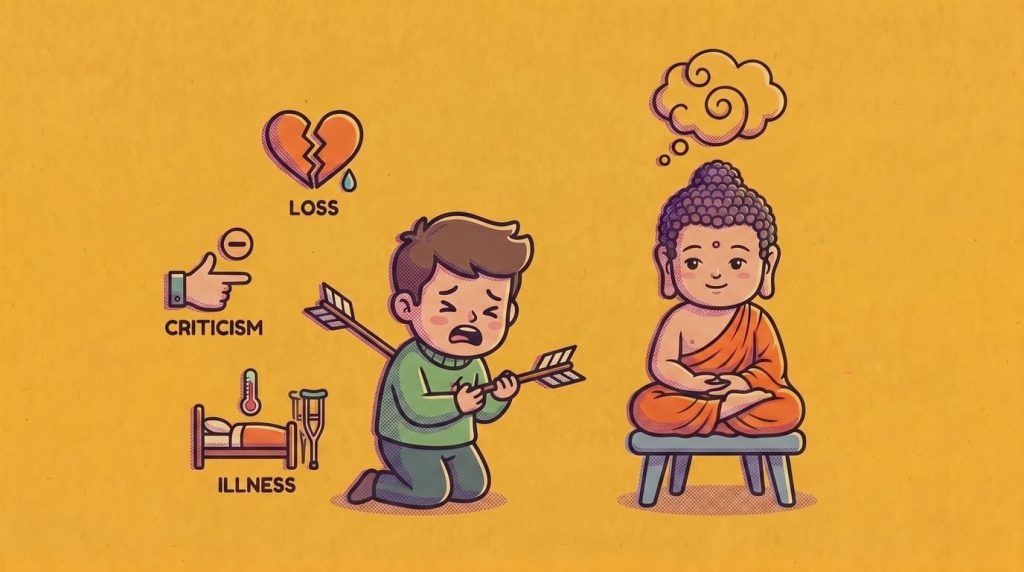
In life, no one can avoid hardships and setbacks. When something painful happens, it is like being struck by the first arrow. It may be a loss, a harsh criticism, an illness, or any form of suffering. That pain is part of the human experience.
The real tragedy begins when we shoot ourselves with a second arrow. This second arrow is our craving and resistance. We resist what has happened, desperately wishing the pain would disappear. We cling to happier moments from the past, longing for reality to be different from what it is.
It is this second arrow that transforms a simple wound into prolonged suffering. We do not suffer only because of what was lost or what occurred; we suffer because we want reality to be other than it is. The gap between what is and what we wish were true becomes a source of ongoing anguish. As long as we keep firing this second arrow of craving and resistance, the wound in our hearts is never given the chance to heal.
Linked Discourses 36.6 1. With Verses An Arrow (Salla Sutta) 36.6
“Mendicants, an unlearned ordinary person feels pleasant, painful, and neutral feelings. A learned noble disciple also feels pleasant, painful, and neutral feelings. What, then, is the difference between a learned noble disciple and an ordinary unlearned person?”
“Our teachings are rooted in the Buddha. …”
“When an unlearned ordinary person experiences painful physical feelings they sorrow and wail and lament, beating their breast and falling into confusion. They experience two feelings: physical and mental.
It’s like a person who is struck with an arrow, only to be struck with a second arrow. That person experiences the feeling of two arrows.
In the same way, when an unlearned ordinary person experiences painful physical feelings they sorrow and wail and lament, beating their breast and falling into confusion. They experience two feelings: physical and mental.
When they’re touched by painful feeling, they resist it. The underlying tendency for aversion towards painful feeling underlies that.
When touched by painful feeling they look forward to enjoying sensual pleasures. Why is that? Because an unlearned ordinary person doesn’t understand any escape from painful feeling apart from sensual pleasures. Since they look forward to enjoying sensual pleasures, the underlying tendency to greed for pleasant feeling underlies that.
They don’t truly understand feelings’ origin, disappearance, gratification, drawback, and escape. The underlying tendency to ignorance about neutral feeling underlies that.
If they feel a pleasant feeling, they feel it attached. If they feel a painful feeling, they feel it attached. If they feel a neutral feeling, they feel it attached.
They’re called an unlearned ordinary person who is attached to rebirth, old age, and death, to sorrow, lamentation, pain, sadness, and distress. They are attached to suffering, I say. The ablative dukkhasmā here is explained by the commentary as taking an instrumental sense, like the preceding terms.
When a learned noble disciple experiences painful physical feelings they don’t sorrow or wail or lament, beating their breast and falling into confusion. They experience one feeling: physical, not mental.
It’s like a person who is struck with an arrow, but was not struck with a second arrow. That person would experience the feeling of one arrow.
In the same way, when a learned noble disciple experiences painful physical feelings they don’t sorrow or wail or lament, beating their breast and falling into confusion. They experience one feeling: physical, not mental.
When they’re touched by painful feeling, they don’t resist it. There’s no underlying tendency for aversion towards painful feeling underlying that.
When touched by painful feeling they don’t look forward to enjoying sensual pleasures. Why is that? Because a learned noble disciple understands an escape from painful feeling apart from sensual pleasures. Since they don’t look forward to enjoying sensual pleasures, there’s no underlying tendency to greed for pleasant feeling underlying that.
They truly understand feelings’ origin, disappearance, gratification, drawback, and escape. There’s no underlying tendency to ignorance about neutral feeling underlying that.
If they feel a pleasant feeling, they feel it detached. If they feel a painful feeling, they feel it detached. If they feel a neutral feeling, they feel it detached.
They’re called a learned noble disciple who is detached from rebirth, old age, and death, from sorrow, lamentation, pain, sadness, and distress. They are detached from suffering, I say.
This is the difference between a learned noble disciple and an unlearned ordinary person.
A wise and learned person does not not feel
the feeling of pleasure and pain. This is the great difference of skill between the wise one and the ordinary.
A learned person who has appraised the teaching discerns this world and the next. Desirable things don’t disturb their mind, nor are they repelled by the undesirable.
Both favoring and opposing are cleared and ended, they are no more. Knowing the stainless, sorrowless state, they who have gone beyond rebirth understand rightly.”
You see, the second arrow reveals itself through resistance: “Why is this happening to me?”, “I want this pain to go away right now,” or by clinging to happier memories in an attempt to escape the present moment.
It is this desire for reality to be different from what it is that becomes the arrow of craving, piercing the heart and preventing the wound from ever truly healing.
The Buddha taught that even a well-trained noble disciple is struck by the first arrow, just like everyone else. Physical pain is still experienced. However, such a person does not fire the second arrow. They do not add mental suffering on top of physical pain. They do not become consumed by grief, complaint, anger, or craving in response to the experience.
Instead, they acknowledge the pain for what it is—an impermanent part of life—and allow it to arise and pass away without resistance. In this way, although the body may suffer, the mind remains free.
Dhammapada, verse 351
One who’s fearless, reached the End,
of craving and of blemish free,
who has becoming’s thorn plucked out,
has this, a final body.
The meaning here is profoundly liberating: freedom is not about finding a world where no arrows exist. Life, by its very nature, is uneven, uncertain, and filled with challenges.
True liberation lies in learning not to wound ourselves with endless craving, resistance, and the demand that life conform to our wishes.
When you accept the first arrow as a natural consequence of causes and conditions, and stop fueling the second arrow with resistance, something remarkable happens. Pain remains, but it is seen simply as pain—a passing sensation in the body. It no longer has the power to invade the mind, steal your peace, or define your experience.
The wound may still be there, but the suffering created around it begins to dissolve. What remains is clarity, acceptance, and a deep inner freedom that cannot be shaken by life’s changing circumstances.
Liberation is not about seeking a world without arrows, but about learning not to wound ourselves with restless longing and compulsive desire.

We cannot change what has already happened, but we can choose not to let our minds be pierced by a second arrow.
This teaching also reveals the remarkable consistency of the Buddha’s teachings. Whenever you encounter the word suffering, it is helpful to remember the original Pāli term: Dukkha. More accurately, Dukkha refers to unsatisfactoriness, incompleteness, or the inability of life to fully conform to our expectations.
With this understanding, we begin to see that much of our suffering comes not from events themselves, but from our struggle against things we find unpleasant, unwanted, or beyond our control.
Because we fail to see things clearly, we are struck by the first arrow. Then, through resistance to reality and our insistence that life unfold according to our wishes, we shoot ourselves with the second arrow.
The first arrow is pain. The second arrow is craving, attachment, and resistance. Together, they create what we experience as suffering.
Buddha Student hopes that this metaphor of the two arrows helps you gain a deeper understanding of Dukkha and its intimate connection to craving. By recognizing the second arrow, we may begin to lay it down—and in doing so, discover a greater sense of peace and freedom.
Craving as a Companion

The most subtle aspect of craving is not the pressure it exerts from the outside, but the way it disguises itself as a loyal companion. The Buddha referred to it as the “second companion” (taṇhā-dutiyo).
In the discourse to Migajāla, the Buddha offered a striking definition of solitude. A person may withdraw into a remote forest, completely separated from society, yet if craving still remains in the mind, that person is not truly alone. They are still accompanied.
This companion—craving—is always present in the background. In moments of silence, it quietly whispers its suggestions, demands, and subtle dissatisfaction. It keeps us restless even when we are by ourselves, creating the persistent feeling that something is missing, that something more is needed before we can be at peace.
As long as the bond between the mind and sense objects continues to be nourished by craving, true solitude remains beyond reach. Physical seclusion alone is not enough.
Genuine solitude is not merely freedom from the crowd outside; it is freedom from the constant companionship of craving within. For what we often flee from is not the noise of the world, but the inner emptiness that this “companion” continuously creates and then promises to fill.
When craving is present, even the deepest forest is crowded. When craving fades, even amidst the world, the mind can know the peace of true solitude.
Saṁyutta Nikāya Connected Discourses on the Six Sense Bases 35.63. Migajala (1) (SN 35.63)
At Savatthi. Then the Venerable Migajala approached the Blessed One, paid homage to him, sat down to one side, and said to him:
“Venerable sir, it is said, ‘a lone dweller, a lone dweller.’ In what way, venerable sir, is one a lone dweller, and in what way is one dwelling with a partner?”
“There are, Migajala, forms cognizable by the eye that are desirable, lovely, agreeable, pleasing, sensually enticing, tantalizing. If a bhikkhu seeks delight in them, welcomes them, and remains holding to them, delight arises. When there is delight, there is infatuation. When there is infatuation, there is bondage. Bound by the fetter of delight, Migajala, a bhikkhu is called one dwelling with a partner.
“There are, Migajala, sounds cognizable by the ear … odours cognizable by the nose … tastes cognizable by the tongue … tactile objects cognizable by the body … mental phenomena cognizable by the mind that are desirable, lovely, agreeable, pleasing, sensually enticing, tantalizing. If a bhikkhu seeks delight in them … he is called one dwelling with a partner.
“Migajala, even though a bhikkhu who dwells thus resorts to forests and groves, to remote lodgings where there are few sounds and little noise, desolate, hidden from people, appropriate for seclusion, he is still called one dwelling with a partner. For what reason? Because craving is his partner, and he has not abandoned it; therefore he is called one dwelling with a partner.
“There are, Migajala, forms cognizable by the eye that are desirable, lovely, agreeable, pleasing, sensually enticing, tantalizing. If a bhikkhu does not seek delight in them, does not welcome them, and does not remain holding to them, delight ceases. When there is no delight, there is no infatuation. When there is no infatuation, there is no bondage. Released from the fetter of delight, Migajala, a bhikkhu is called a lone dweller.
“There are, Migajala, sounds cognizable by the ear … odours cognizable by the nose … tastes cognizable by the tongue … tactile objects cognizable by the body … mental phenomena cognizable by the mind that are desirable, lovely, agreeable, pleasing, sensually enticing, tantalizing. If a bhikkhu does not seek delight in them … he is called a lone dweller.
“Migajala, even though a bhikkhu who dwells thus lives in the vicinity of a village, associating with bhikkhus and bhikkhunis, with male and female lay followers, with kings and royal ministers, with sectarian teachers and their disciples, he is still called a lone dweller. For what reason? Because craving is his partner, and he has abandoned it; therefore he is called a lone dweller.”
This “companion” of craving is always present in the background of our lives. In moments of silence, it quietly generates suggestions, demands, and a subtle sense of dissatisfaction. It leaves us feeling that something is still missing, that somehow what we have is not quite enough—even when we are completely alone.
As long as our attachment to sense objects continues to be sustained by craving, we have not yet tasted true solitude. Physical isolation by itself is not genuine seclusion.
We often think we are trying to escape the crowd, but in reality, we are trying to escape the emptiness that this very companion creates within the mind.
Yet the Buddha also offered a deeply hopeful vision. When a person has completely abandoned this “second companion” of craving, something profound becomes possible:
They are no longer driven by the need to seek fulfillment outside themselves. They are no longer haunted by the feeling that something is missing. Whether alone or among many people, their peace does not depend on circumstances.
Having let go of craving, they finally know the freedom of true solitude—not the loneliness of separation, but the completeness of a mind that is no longer searching for anything to make it whole.
“Migajala, even though a bhikkhu who dwells thus lives in the vicinity of a village, associating with bhikkhus and bhikkhunis, with male and female lay followers, with kings and royal ministers, with sectarian teachers and their disciples, he is still called a lone dweller. For what reason? Because craving is his partner, and he has abandoned it; therefore he is called a lone dweller.”
The meaning of this teaching is profoundly practical: true solitude does not come from escaping the world, but from bringing an end to the ongoing conversation with the inner companion called craving.
As long as we continue to indulge subtle desires and attachments, we are like prisoners who carry their jailer with them into a place of seclusion. Changing our surroundings may bring temporary relief, but it cannot bring genuine freedom.
Only when this companion falls silent does the mind begin to taste perfect stillness. In that silence, there is nothing to pursue, nothing to resist, and nothing missing.
This is the state of a truly free person—one who can dwell peacefully in the depths of a forest and remain equally at ease amid the noise and busyness of the city.
For freedom is not found in a particular place. It is found in a mind that no longer depends on craving for its sense of completeness. When the inner companion is gone, peace is no longer something to be sought—it is simply what remains.
Only when this second companion disappears can the mind truly experience the absolute stillness of genuine freedom.
The Mechanism of the Arising of Craving
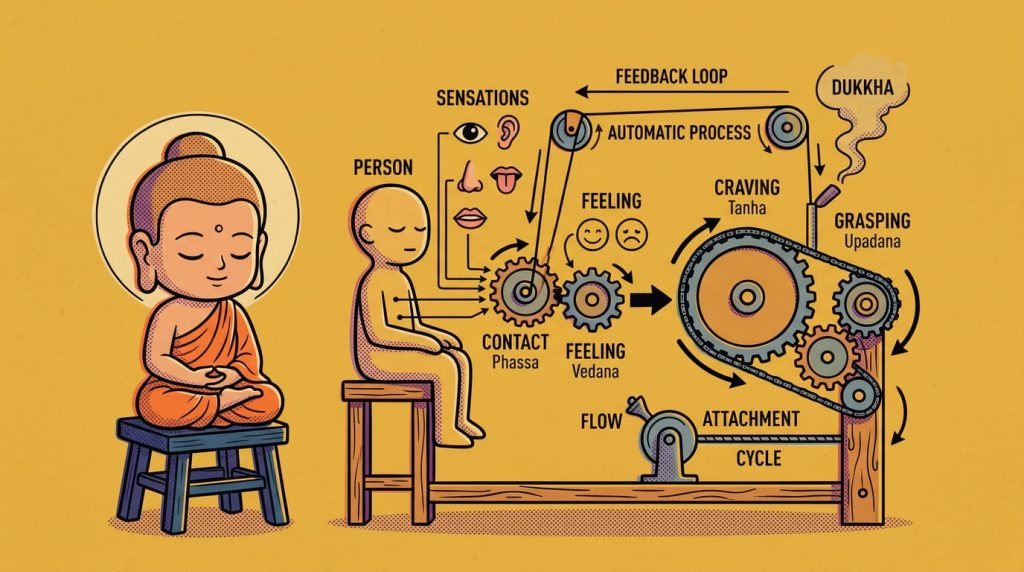
The Complete Process: From Contact to Suffering
Contact → Feeling → Craving → Clinging → Becoming → Suffering
- Contact (Phassa): The senses come into contact with an object.
- Feeling (Vedanā): A pleasant, unpleasant, or neutral feeling arises.
- Craving (Taṇhā): We want to hold on to what feels pleasant and push away what feels unpleasant.
- Clinging (Upādāna): We become attached and begin to regard it as “mine.”
- Becoming (Bhava): Habits, identity, and patterns of behavior take shape around that attachment.
- Suffering (Dukkha): Anxiety, conflict, disappointment, and suffering follow.
Put more simply:
See/Hear → Feel → Want → Hold On → Defend → Suffer
For example:
You see a beautiful object and feel attracted to it. That pleasant feeling gives rise to the desire to possess it. After obtaining it, you become attached to it and begin to think of it as “mine.” Then come the worries: fear of losing it, fear of it being damaged, fear that someone else might take it away. From that attachment, stress and suffering naturally arise.
This is how suffering often develops—not because of the object itself, but because the mind moves from simple experience to craving, from craving to attachment, and from attachment to suffering. The object may remain unchanged, yet the mind creates an entire world of anxiety around it.
To bring this cycle to an end, we need to focus on one of its most critical links: Feeling conditions Craving (vedanā-paccayā taṇhā).
Craving does not arise randomly. It functions as a conditioned response shaped by perception and emotion.
In the chain of dependent origination, the Buddha pointed to a crucial principle:
“With feeling as a condition, craving arises.” (vedanā-paccayā taṇhā)
Whenever a feeling arises—pleasant, unpleasant, or neutral—the mind tends to react automatically:
- Pleasant feelings are grasped and prolonged.
- Unpleasant feelings are resisted and pushed away.
- Neutral feelings are often ignored, allowing ignorance to remain unnoticed.
Consider a thirsty man who comes across a delicious drink that he knows is poisoned. Despite understanding the danger, the intensity of his thirst drives him to drink it anyway. In the same way, craving can overpower wisdom when the mind becomes captivated by immediate pleasure.
The process unfolds step by step:
Contact (Phassa)
Contact occurs when one of the six sense faculties—eye, ear, nose, tongue, body, or mind—meets its corresponding object, and consciousness arises.
Feeling (Vedanā)
Almost instantly, the experience is accompanied by a feeling tone: pleasant, unpleasant, or neutral.
Craving (Taṇhā)
In the absence of mindfulness, feeling quickly gives rise to craving.
- Pleasant feelings trigger the desire to prolong, repeat, or possess the experience.
- Unpleasant feelings trigger aversion, resistance, or the urge to escape.
- Neutral feelings often lead to dullness and unawareness.
The mind switches into a mode of seeking and grasping, constantly searching for satisfaction or relief.
Clinging (Upādāna)
When craving is repeatedly indulged, it hardens into clinging. What began as a simple desire becomes a deep attachment to objects, views, identities, experiences, or even the idea of a permanent self.
Craving is sustained by focusing on what the Buddha called the “sweetness” (assāda) of an experience—the attractive and pleasurable aspects that capture our attention while concealing its limitations and consequences.
Just as a fire continues to burn when fuel is constantly added, craving continues to grow when it is repeatedly fed.
When we habitually perceive things as sources of lasting happiness or as something that belongs to us, craving receives a constant supply of fuel and keeps burning.
Put simply:
Craving never appears by accident. It operates as a conditioned mechanism within the mind.
To understand suffering, we must understand this pivotal link:
Contact gives rise to feeling. Feeling gives rise to craving. Craving gives rise to clinging.
The moment of feeling is where the cycle can be interrupted.
When mindfulness is present, a feeling can simply be known as a feeling—pleasant, unpleasant, or neutral—without immediately becoming craving. This is the doorway through which freedom becomes possible.
The entire process of “Feeling Conditions Craving” (vedanā-paccayā taṇhā) can be summarized in the diagram below:
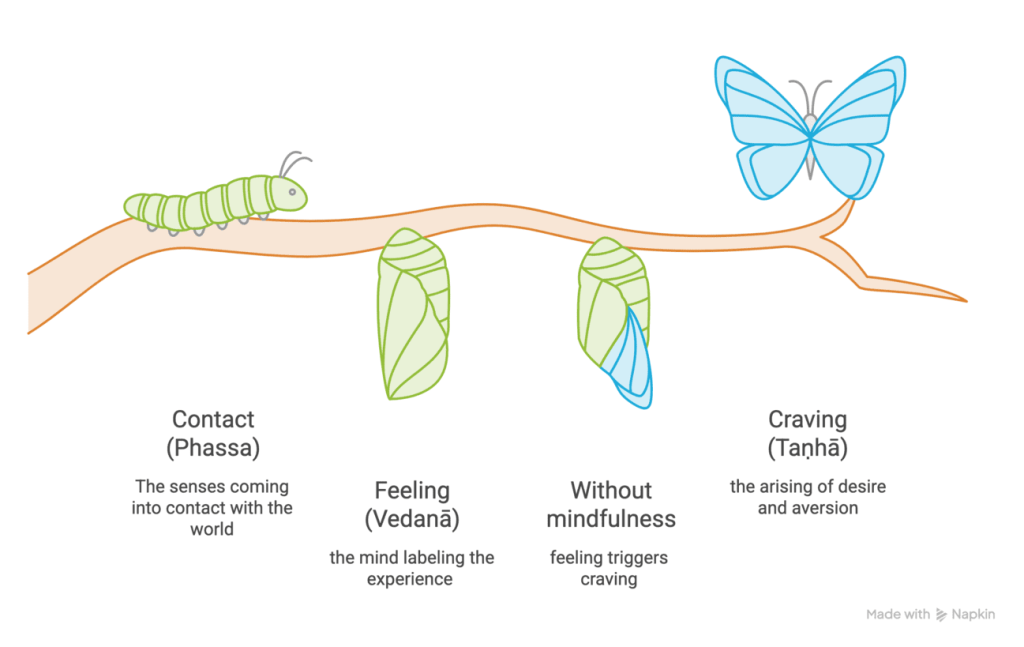
Everything always begins with “contact” (phassa), the moment when our senses come into contact with the world around us. It may be the eye seeing a form, the ear hearing a sound, or a thought arising in the mind.Contact (Phassa) – when the senses and the mind come into contact with the world.
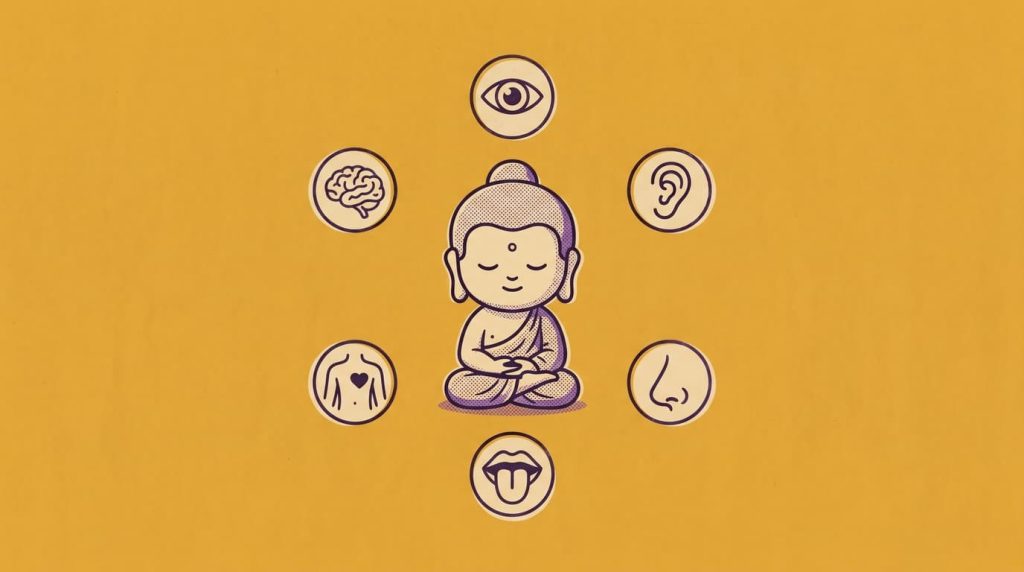
Contact (Phassa) – when the senses and the mind come into contact with the world
Immediately, the mind assigns an emotional label to the experience, which the scriptures refer to as “feeling” (vedanā). This feeling may be pleasant (sukha vedanā), unpleasant (dukkha vedanā), or neutral (upekkhā vedanā).
This is a natural biological response. However, the tragedy begins right after this point.

Feeling (Vedanā) – the mind begins to label the experience as pleasant, unpleasant, or neutral.
If mindfulness and clear awareness are absent, this stage of feeling (vedanā) immediately triggers the ignition of craving (taṇhā).
When a feeling is pleasant, the mind arises with desire—it wants to prolong it, to possess it, to hold onto it at all costs. When a feeling is unpleasant, the mind generates aversion, wanting to push it away or eliminate it entirely.
The natural tendency of the mind is to avoid suffering and seek pleasure.
Yet it is precisely this instinct, when unexamined, that becomes the root of suffering.
For example, imagine a person who is desperately thirsty encountering a bowl of cold, refreshing water—unaware that it is poisoned. Even with partial knowledge of the danger, the intensity of the immediate relief can be so strong that the person still drinks it. This is how craving deceives us. We become fixated on the “sweetness” on the surface of experience while ignoring the latent danger within it.
When we repeatedly and mistakenly assume that these pleasant experiences belong to us and should be held onto permanently, it is as if we are continuously adding fuel to a fire—the flame of craving burns brighter and never goes out.
From this initial thirst, the mind begins a subtle psychological and ethical descent. Once we obtain what we want, we do not simply stop there. We begin to strategize how to use it, and attachment intensifies until we identify ourselves with the object itself. At this point, the sense of “this is mine” becomes very strong, giving rise to stinginess, fear of loss, and the unwillingness to share.
To protect this constructed sense of ownership, people build emotional and social defenses, which can escalate into conflict, accusation, and even violence. Many arguments within families and tensions in society are, at their root, the final outcome of allowing an initial feeling to carry the mind too far along this chain.
Therefore, the path of liberation taught by the Buddha is not the suppression of feeling, but the interruption of the automatic link between feeling and craving.
When a pleasant or unpleasant feeling arises, if you are able to mindfully recognize: “This is just a feeling,” instead of reacting habitually, you begin to see the machinery of craving slowing down and coming to a halt.
You are no longer like a frightened rabbit caught in a trap, struggling blindly. Instead, you become a clear-sighted observer, standing outside the vortex of compulsive desire.
Contact → Feeling → (Mindfulness) → Cessation
The Nine States Arising from Craving (Taṇhā-mūlaka)
The Buddhist scriptures describe a psychological and moral “downward progression” that originates from craving:
1. Seeking (pariyesanā): The initial impulse of desire, the restless search for what is wanted.
2. Acquisition (lābha): The object of desire is obtained.
3. Decision (vinicchaya): One begins to calculate and strategize how to use what has been gained.
4. Desire and passion (chanda-rāga): Attachment intensifies; fascination and emotional investment grow stronger.
5. Clinging (ajjhosāna): The sense of identity becomes fused with the object; one begins to internalize it as part of oneself.
6. Possession (pariggaha): The notion of “this is mine” firmly arises.
7. Stinginess (macchariya): The unwillingness to share emerges, along with possessiveness.
8. Protection (ārakkha): Fear of loss leads to guarding, defensiveness, and the construction of mental and external barriers.
9. Violence: Ultimately, this progression can culminate in conflict—taking up weapons, verbal aggression, accusations, and other harmful actions.
This teaching illustrates how craving, when left unexamined, does not remain a simple mental desire. It gradually evolves into identification, possession, fear, and finally destructive behavior.
The Way to Overcome Craving

The ultimate goal of Buddhism is not to force us into extreme repression of desires or to live a dry, joyless life. Rather, it points toward a far more noble state known as the complete cessation of craving.
Imagine this cessation as uprooting suffering at its very source. It is a state in which all the “ignitions” that fuel the cycle of rebirth, all the restless attachments and compulsive tendencies, have been completely extinguished. In the scriptures, Nibbāna is essentially defined as the complete absence of this fire of craving.
This raises an important question: how can we truly let go when life is still full of temptations and desires?
Abandoning a deeply ingrained habit or desire cannot be achieved through sheer willpower or suppression. Instead, we need a structured path of practice—one that gradually transforms our perception and trains continuous mindfulness in every moment.
Below are five fundamental steps for working with and overcoming craving, which you can begin practicing immediately after listening to this teaching.
The Path to the Cessation of Craving
To let go of craving, the first step is to cultivate wisdom that sees clearly the true nature of the objects we desire. Through mindfulness practice, the practitioner reflects and recognizes that all phenomena and pleasures in the world share three fundamental characteristics:
- Impermanence (Anicca): Nothing lasts forever. All pleasurable feelings are fragile—they arise and then inevitably pass away.
- Unsatisfactoriness (Dukkha): Because they are impermanent, such experiences cannot provide ultimate or lasting fulfillment.
- Non-self (Anattā): There is no inherent, fixed self behind these phenomena; they are impersonal processes arising and passing due to conditions.
When one clearly perceives the danger (Ādīnava) of chasing sensual pleasures—seeing them as poisoned bait or as illusory reflections—the mind naturally gives rise to dispassion (nibbidā) and letting go (virāga). Instead of craving, one develops equanimity and release, gradually uprooting the fantasies of attachment.
Overcoming craving requires a systematic path of practice that integrates insight and mental cultivation in a continuous, disciplined way.
Step 1: See through the danger that lies beneath every “sweet taste.”
The main reason we are led by craving is that the mind tends to focus only on the immediate, stimulating aspect of experience—what the scriptures call “the sweetness” (assāda).
To counter this, we need to cultivate the perception of “danger” (ādīnava).
Take the pursuit of fame or social validation as an example. The “sweetness” is the momentary satisfaction of seeing likes increase or receiving praise from others. But if you look more deeply with clarity, you begin to see the “danger” as the hidden cost: the anxiety when engagement drops, the exhaustion of constantly maintaining an idealized image that is not real, and the inner emptiness that arises when your sense of self-worth depends on the approval of others.
A stark image to awaken insight is this: chasing sensual pleasure is like a starving wolf relentlessly gnawing on a dry bone with no meat left—endlessly chewing, yet never truly satisfied.
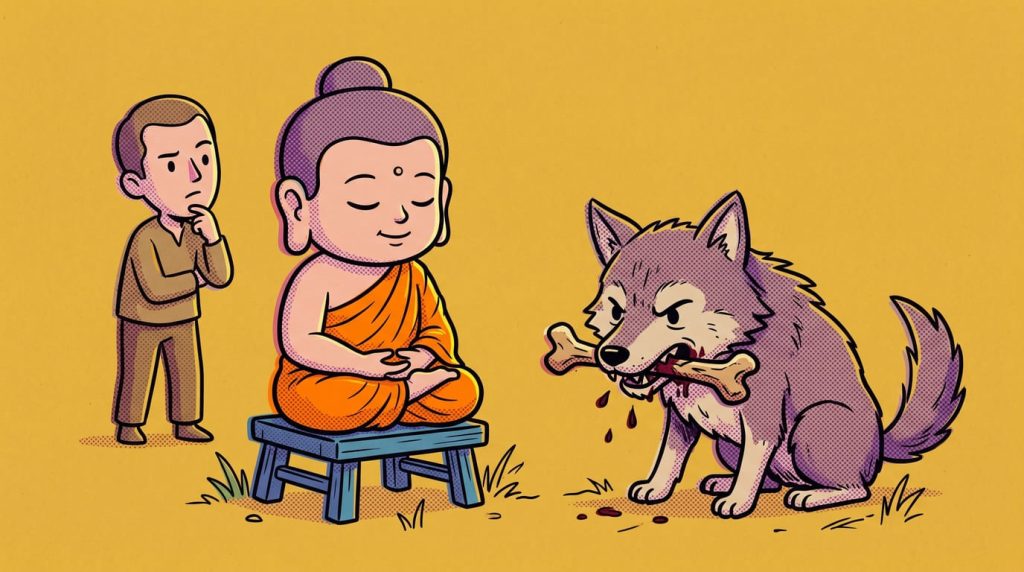
It keeps gnawing away, thinking it is something nourishing, but in reality it is only licking its own blood as sharp bones tear into its gums.
Or it is like someone suffering from a severe skin condition: overwhelmed by itching, they hold their hands over a flame to find momentary relief. Yet that very action only worsens the wounds and makes the condition more painful and inflamed.
When you begin to cultivate the habit of seeing the “dark side” of desire—its costs, its exhaustion, and its impermanent nature—craving naturally weakens. It loses its power to deceive you, because you are no longer under the illusion of its sweetness.
Step 2: Contemplation of the body’s impurity (Asubha) and the establishment of mindfulness (Satipaṭṭhāna)
We are often driven by craving because we only perceive the glossy surface of the world.
Contemplation of the body’s impurity (Asubha):
This is a meditative practice that focuses on the less attractive aspects of the body—such as reflecting on its anatomical components like hair, flesh, bones, and other bodily parts—rather than being captivated by outward appearance.
The purpose of this practice is to directly counter sensual desire. It helps weaken attachment and sexual craving, gradually replacing passion with a calm, detached, and equanimous attitude of letting go.

Mindfulness (Satipaṭṭhāna):
This refers to the fundamental practice of observation and clear awareness. Mindfulness allows you to recognize habits, sensations, and thoughts exactly as they arise in the present moment, without immediately reacting to them.
Texts describe this as the most direct path for developing wisdom, enabling one to see reality as it truly is.
In essence, contemplation of bodily impurity (Asubha) is taught as part of the broader framework of mindfulness practice—specifically within mindfulness of the body.
Although this may sound austere, in practice it functions as a highly effective psychological method.
For example, when you feel desire for a luxury item or are captivated by someone’s attractive appearance, try breaking it down analytically.
A luxury garment is ultimately nothing more than woven threads of fabric. A beautiful body, if left unmaintained for only a few days, will naturally begin to decay, lose freshness, and become unpleasant.
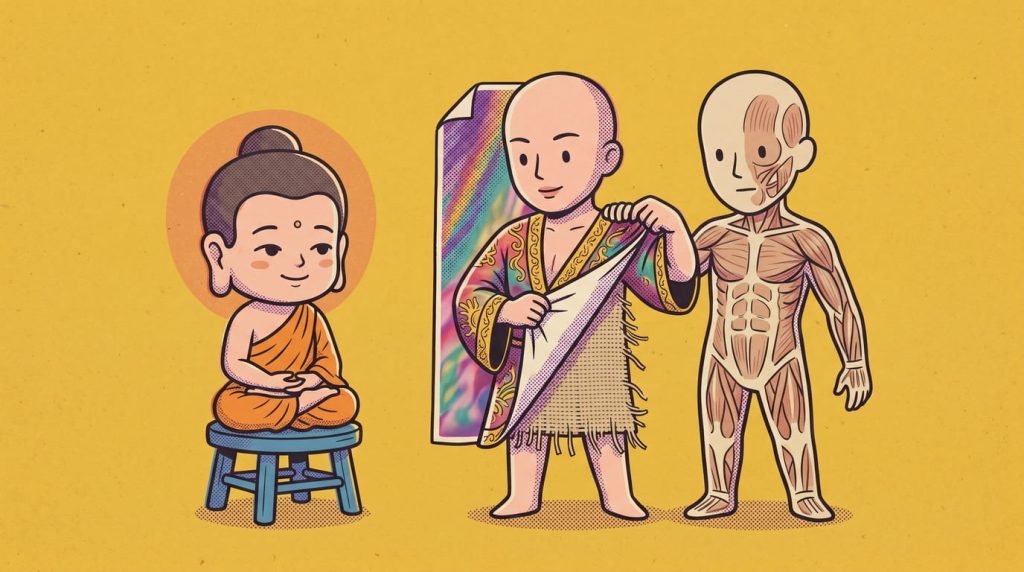
Mindfulness, in this context, functions as a neutral observer.
When a craving arises in the mind, instead of immediately acting on it, you simply sit still and observe the process unfolding. You clearly note:
“Ah, my breath is becoming shallow and rapid, my mind feels restless, and thoughts about that object are taking over.”
When you observe without reacting, you begin to see that this wave of craving is also impermanent—it arises, reaches a peak, and then naturally dissolves.
As you recognize this pattern, you realize that you do not have to be a slave to every emotion or impulse that appears in the mind. And that recognition itself marks the very first moment of true freedom.
Step 3: The Strategy of “Using Craving to Eliminate Craving” (Taṇhaṃ nissāya taṇhā pahātabbā)
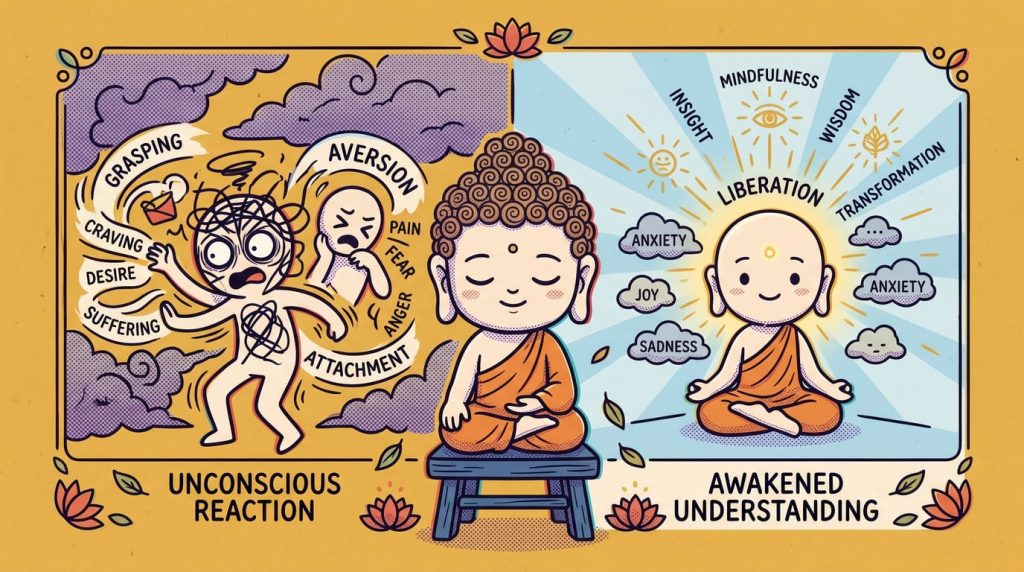
This is a compassionate instruction attributed to Venerable Ānanda, designed to help us avoid falling into extremes.
The truth is that one cannot immediately arrive at a state where all forms of wanting have completely ceased. Therefore, instead of trying to violently suppress desire, we are encouraged to skillfully replace unwholesome desires with more wholesome and elevated ones (taṇhaṃ nissāya taṇhā pahātabbā).
Rather than craving sense pleasures that deplete the mind, one can redirect that same energy toward craving wakefulness and clarity. Instead of craving victory over others or worldly gain, one can cultivate a longing for peace, stillness, and inner freedom.
In this way, we use the very “wanting” for liberation—our aspiration to awaken, to become a mindful and awakened person—as the driving force to transcend more superficial and harmful forms of desire.
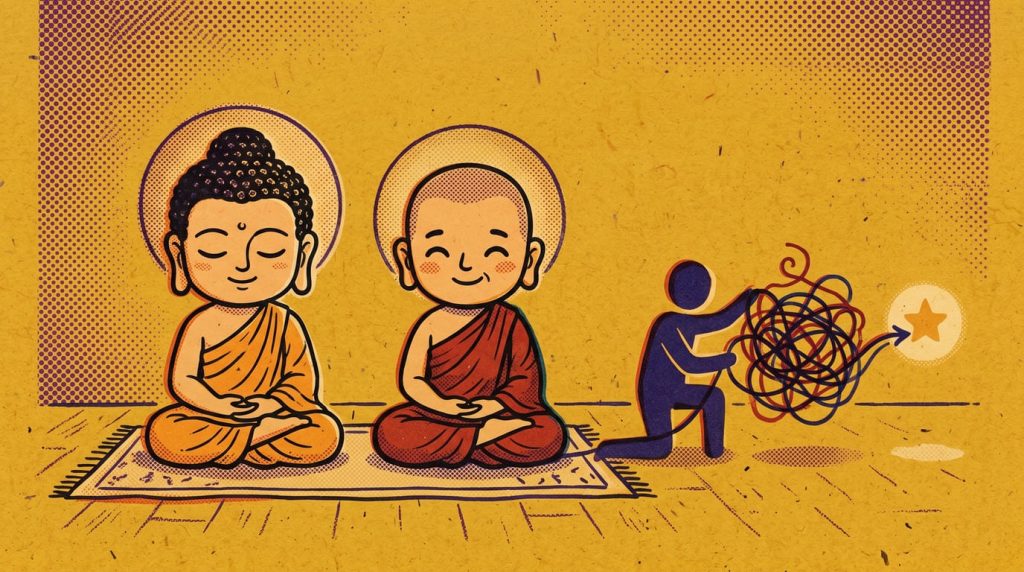
Venerable Ānanda’s teaching on Taṇhaṃ nissāya taṇhā pahātabbā
You can regard these wholesome aspirations as a sturdy raft used to cross the river of suffering.
While you have not yet reached the other shore, you still need to hold onto the raft. Only when the mind has become truly stable and wisdom fully matured does even the aspiration for liberation naturally fall away—just as one steps onto the shore and no longer needs to carry the raft on one’s shoulders.
In simple terms, liberation from craving is like building a raft to cross the river. But once the far shore is reached, the raft must also be let go.
This means cultivating wholesome forms of desire—such as the aspiration to study and practice the Dhamma for liberation—while recognizing that even this “desire for liberation” is ultimately to be released once it has fulfilled its purpose.

If craving is likened to a wall, then the Buddha’s teaching is the heavy hammer that helps you break through the wall of ignorance. But once the wall has already collapsed, you must also learn to put the hammer down.
It is worth remembering that many people become trapped in the attachment to knowing the Dhamma—they accumulate teachings, concepts, and intellectual understanding, yet remain bound by the subtle pride of “I know.” At the same time, even more people fall into the opposite extreme, using the idea of “not clinging to teachings” as an excuse to avoid studying and practicing altogether.
If you find yourself in either of these positions, you are still caught in a very subtle form of craving. It is a refined trap that does not always appear as desire, but as attachment to views or aversion disguised as spiritual freedom.
Step 4: The Importance of Equanimity (Upekkhā) and Wisdom of Non-Self (Anattā)
Equanimity (Upekkhā) and the Wisdom of Non-Self (Anattā) are two closely interdependent factors that play a crucial role in the attainment of ultimate liberation.
Equanimity (Upekkhā) is not indifference or emotional detachment. Rather, it is the capacity to observe all experiences with clarity and mindfulness without being carried away by changing conditions. It keeps the mind balanced and represents a supreme state that completes and refines the other wholesome qualities such as loving-kindness, compassion, and sympathetic joy, as well as the factors of awakening.
Wisdom of Non-Self (Anattā) is the direct insight that all sensations and experiences are constantly changing, and therefore there is no permanent “self” or fixed identity behind them that is either enjoying or suffering these experiences.
When combined, these two qualities become deeply supportive of one another. In essence, equanimity in Buddhism is the absence of identifying phenomena as “me” or “mine.”
When the wisdom of non-self dismantles the illusion of a fixed identity, equanimity arises naturally and fully matures. At this stage, the mind attains profound freedom because nothing is any longer taken as “I” or “mine.”
Imagine watching a dramatic film. You may laugh or cry with the characters, yet deep down you always know that what you are seeing is only images on a screen—it is not you.
Life is similar. When you understand that all experiences—pleasure and pain, fame and loss—are merely shifting phenomena, with no fixed “self” behind them to own or be defined by them, you stop appropriating everything into your personal identity.
There is no longer any need to grasp in order to affirm yourself, nor to push away in order to protect yourself.
As the illusion of self dissolves, equanimity develops to its fullest extent. In this freedom, nothing remains that can truly be hurt, because nothing is taken as “self” to begin with.
Step 5: Practicing the Noble Eightfold Path toward complete cessation (Nirodha)
The most comprehensive and definitive solution for eradicating craving is the Noble Truth of the Path—the Noble Eightfold Path (Ariya Aṭṭhaṅgika Magga).
Right View (Sammā-diṭṭhi) and Right Intention (Sammā-saṅkappa) correct distorted perceptions of self and reality. They replace craving with wholesome aspiration (chanda)—the sincere wish for liberation.
Right Speech (Sammā-vācā), Right Action (Sammā-kammanta), and Right Livelihood (Sammā-ājīva) establish the foundation of ethical conduct (sīla). They restrain impulsive actions driven by craving and cut off unwholesome conditions that generate further suffering.
Right Effort (Sammā-vāyāma), Right Mindfulness (Sammā-sati), and Right Concentration (Sammā-samādhi)cultivate meditative development, especially insight meditation (vipassanā). Through this training, the practitioner learns to observe feeling (vedanā)—the crucial link in dependent origination where craving arises—with complete equanimity.
Instead of allowing “feeling to condition craving” (vedanā-paccayā taṇhā), the practitioner observes the arising and passing away of sensations objectively, transforming the process into “feeling conditions wisdom” (vedanā-paccayā paññā).
When mindfulness becomes strong enough to interrupt this link, craving is isolated, weakened, and eventually extinguished without residue. This is the realization of Nibbāna—the ultimate cessation of greed, hatred, and delusion, and the complete liberation from the cycle of birth and death.
Practice is not limited to the meditation cushion; it extends into every aspect of daily life. From correcting views through Right View, to refining speech, actions, and livelihood, the entire path is a continuous training of mind and conduct.
The key point, however, lies in the observation of feeling (vedanā)—the very doorway through which craving arises within dependent origination.
For example, when tasting something delicious, instead of immediately thinking, “I must have this again,” you simply recognize: “This is sweetness; this is a pleasant feeling arising.”
In this way, the process shifts from “feeling conditions craving” to “feeling conditions wisdom.”
When sensations are observed clearly as they arise and pass away, craving loses its fuel and can no longer sustain itself. The fire of greed, hatred, and delusion subsides, giving way to the stillness of Nibbāna—a state of true rest, free from the torment of compulsion and thirst.
It is also important to understand that mental states occur at an extremely rapid scale—far faster than ordinary perception, arising and ceasing countless times within even a single second.
Therefore, moments of deep clarity and cessation can occur, but without continued practice, defilements may reappear. For this reason, consistent and continuous training in the Dhamma is essential.
Types of Liberation (Vimutti)
Temporary Liberation (Sāmāyika):
Through the cultivation of the Four Immeasurables (loving-kindness, compassion, sympathetic joy, and equanimity), the mind expands boundlessly and is ‘freed’ from ill will, cruelty, dissatisfaction, and craving. This state is powerful and can temporarily counteract unwholesome tendencies. However, it remains impermanent and can be lost if the practitioner becomes overcome by illness, excessive sleep, idle talk, or lack of mindfulness.
Unshakable Liberation of Mind (Akuppā Cetovimutti):
This is absolute freedom. It is described through three dimensions:
- Immeasurable (appamāṇa): beyond the limits of greed, hatred, and delusion.
- Nothingness (akiñcaññā): free from attachment to anything whatsoever.
- Signless (animittā): no longer deceived by appearances or conceptual constructs.
It arises from profound insight into the emptiness of self (suññatā cetovimutti). At this point, liberation is likened to the extinguishing of a lamp’s flame—Nibbāna—where all conditioned sensations and perceptions come to complete stillness.
Types of Liberated Individuals (By Practitioner):
Liberated through Faith (Saddhāvimutta):
Relying on deep confidence in the Buddha, Dhamma, and Saṅgha, such practitioners eliminate certain defilements (as in stream-enterers or once-returners). They are freed from doubt and from rebirth in lower realms.
Liberated through Wisdom (Paññāvimutta):
These are arahants who have eradicated all ignorance through direct insight into non-self. Notably, they do not necessarily possess supernormal powers or attain the immaterial absorptions.
Liberated in Both Ways (Ubhatobhāgavimutta):
These are the most complete arahants. They possess both perfect wisdom and mastery over the full range of liberations (vimokkha), including the deepest meditative attainments.
The Culmination of the Noble Eightfold Path
Within the Noble Eightfold Path, the highest realization is Right Liberation (Sammā-vimutti), inseparable from Right Knowledge (Sammā-ñāṇa)—the direct knowing that liberation has been attained.
The gateway to liberation opens only when one integrates both:
- Concentration (samatha): calming the mind and weakening craving.
- Insight (vipassanā): developing wisdom that eradicates ignorance.
At this stage, the practitioner has uprooted craving at its root, lowered the banner of conceit, and permanently laid down the burden of the ‘self.’
Conclusion
To conclude our exploration of craving (taṇhā), let us take a step back and view the complete picture we have been tracing together.
Craving is, in essence, a vast “mechanism” that quietly drives the wheel of suffering and continuously reinforces the illusion of a permanent “self.”
Through the Buddha’s many metaphors—from deep-rooted vines entangling a tree, to creeping creepers suffocating life, to the image of a “tailor” stitching together fragments of feeling—the Dhamma reveals the intricate structure and binding power of this thirst for existence.
Yet the core message here is not one of pessimism or rejection of life. On the contrary, it is a message of profound hope. The Buddha teaches that no matter how powerful craving may appear, it is still a conditioned process. And whatever is conditioned to arise can also be brought to cessation.
By applying wise attention (yoniso manasikāra) in the present moment—learning to see things as they truly are rather than through the lens of desire—we gain the ability to recognize and refuse the mind’s most subtle traps.
When you walk the Noble Eightfold Path and train the mind not to be pulled by waves of feeling, the fire of existential craving begins to subside.
And as that fire fades, the taste of true liberation naturally reveals itself: a state of complete freedom, an immeasurable lightness in which one is no longer bound or driven by fear, compulsion, or attachment to worldly conditions.
You still live, still work, still love—but you are no longer like a rabbit caught in a snare or a spider trapped in its own web.
However, one sincere reminder must be kept in mind: overcoming craving is an inner revolution that demands great effort, because it goes directly against the instinctive habits of survival. We are conditioned to seek security through possession, and to construct identity in order to feel worthwhile. For this reason, intellectual understanding alone is not enough. Defeating the “Mara” of craving requires persistent practice and continuous mindfulness in every breath, every step.
Each time you recognize a rising desire and choose to remain still instead of reacting, each time you resist being swept away by the current of craving and return to calm awareness, you move one step closer to true happiness. Freedom is not a gift granted from outside—it is the result of a mind that has courageously broken its own chains.
Thank you for accompanying this journey through the teaching on craving. May you always keep the lamp of mindfulness bright, so you may walk freely through the changing currents of life.
And finally, may we remember the Buddha’s final exhortation:
Be islands unto yourselves, be your own refuge, with no other refuge;
let the Dhamma be your island, let the Dhamma be your refuge, with no other refuge.
Frequently Asked Questions About Craving (FAQ)
In the scriptures, Taṇhā refers to craving driven by selfishness and leading to suffering. In contrast, Chanda can be neutral. There is also “wholesome desire” (dhamma-chanda)—the aspiration for practice and liberation—which is considered a necessary motivation on the spiritual path.
This form of craving manifests as aversion toward life, a longing for death as an escape, or, in meditation, the desire to completely dissolve so as to avoid responsibility or suffering. It is a form of attachment to the notion of “non-existence.
Because craving is always present in the mind, silently shaping our decisions and emotions. We often mistake its demands for our true intentions.
According to the path of morality (sīla), concentration (samādhi), and wisdom (paññā), along with deep contemplation of its drawbacks (ādīnava)—as analyzed by Anālayo—a person with determination and the right method can gradually weaken and ultimately eradicate craving.